

Sometimes there’s not much in a name. MacBook is iconic, sure, and it tells you exactly what that product is, but all of Apple’s laptops are some variation of that name. Dell has gone simplistic with its Dell 14 Plus and 16 Plus lines, while their gaming division Alienware continues with the far-out theme of Area 51 and Aurora for its portables.
Enter MSI’s Titan. This is perhaps the most appropriate name for a computer of this stature, not only physically, but in the brute force and strength it encompasses. A titan is something of great strength, intellect, and power, and MSI delivers in each of these areas in an astounding way. It’s also heavy as all heck, but something’s gotta give.
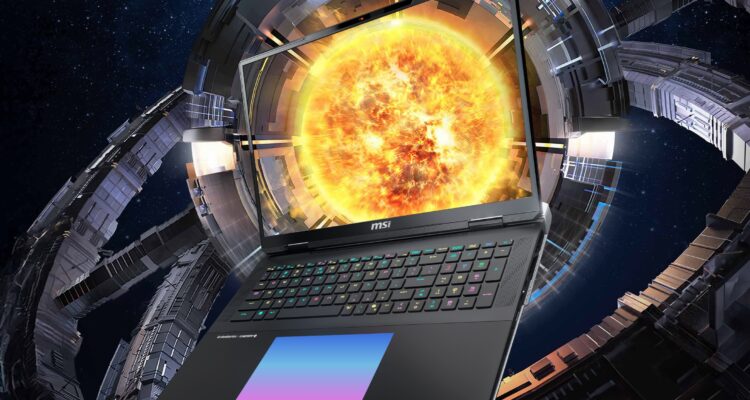
Say what you will about its design, the MSI Titan HX 18 is a beast of a machine. It won’t win any awards for the thinnest, sleekest chassis, nor the quietest fans or being the easiest to carry. But it’s not trying to. This machine, in every sense of the phrase, is a true desktop replacement. And it starts right with the specs:
- Intel’s latest Core Ultra 9 Processor 285HX
- Up to 5.5GHz clock speed, 24 Cores, 36MB cache
- NVIDIA GeForce RTX 5090 24GB
- 64 GB DDR5 RAM
- 6TB SSD
And that’s just the insides. Showing off all that power is a gorgeous 18-inch UHD+ MiniLED display pushing out 3840 x 2400 pixels, resting atop a Steelseries Cherry keyboard with haptic trackpad that is as glassy and smooth as the best of them.
Every other spec is the latest and greatest: in addition to being one of the first RTX 5090 laptops on the market, the Titan 18 HX also has two Thunderbolt 5 ports, Wi-Fi 7, the ability to upgrade to 96GB of RAM (you know, if the 64GB isn’t cutting it), and four total SSD slots, one of which is PCIe Gen5. And to power all this? A 400W power adapter. Yes, four hundred.
But how does this all stack up in real-world testing?
There are naturally more than a few use cases for a laptop like this. Workstations like this could be for filmmaking or audio production, physics and chemical simulations, animation, broadcasting, and the list goes on. But we here are gamers, so we’re going to put this thing to the test as such.
We’d love for you to read the rest of the review, but let’s just be clear, in case you had any worry: this thing beats out anything we’ve ever tested by a mile. And then another mile after that.
Our usual suspects for games testing with all the bells and whistles, 4K resolution, ray-tracing, DLSS, the usual shows just what this thing is capable of:
- Cyberpunk 2077: 63 fps
- Starfield: 136 fps
- Star Wars: Outlaws: 87 fps
These numbers can be caveated a bit by the fact that these are using 3x frame-generation with NVIDIA’s new transformer models. There will likely always be some artifacts present with AI-generated frames, but they were so minimal that they were never more than a fleeting distraction, and only when frame rates were low enough to really notice. In Starfield and Outlaws, they were virtually imperceptible, while in Cyberpunk, perhaps because we still always expect there to be a hiccup, they seemed a bit more obvious, but even that might be a stretch.
While much of the power in this beast as it pertains to gaming certainly comes from the RTX 5090 that has somehow been shoved into this machine, plenty can be attributed to Intel’s top-of-the-line 285HX processor itself. This is, in every sense of the phrase, a true desktop replacement.
Side note: it’s also a desktop replacement because you’ll likely want it tethered to the wall; the battery on this thing is quite abysmal, but again, MSI isn’t exactly targeting the 12-hour flight crowd with this thing. I’m pretty sure plugging this into the plane would cause your in-seat power to, well, stop providing power, and the fans on this thing to be the only thing certifiably loud enough to drown out the crying baby three rows back, but I digress.
With a multithread rating over 62,000, and a single thread just under 5,000, the Intel Core Ultra 9 285HX is the current top dog in laptop processors. Other than AMD’s top chip in the same space, all other competitors to the 285HX are about 10% less performant at best, some as much as 33% less.
What about the GTA VI Benchmark? Okay, that’s not a real thing, but how will a game like Grand Theft Auto 6 run on the Titan 18HX AI? Spectacularly well, without a doubt. Will it be pushed to its limits? Knowing Rockstar, maybe, but given that they also have to make their game such that it’s capable of running on a machine that doesn’t cost $8,000, no, not even to its limits.
Which brings us to perhaps the bank account elephant in the room: this computer is roughly $8,000 as of the time of writing. While that’s nothing to sneeze at, certainly, it’s also not designed for the casual gaming market. This is, I’ll say it again, a complete desktop replacement. And a replacement for what is likely a significantly beefy desktop in and of itself.
In the end, the MSI Titan 18 HX isn’t trying to please everyone, it’s trying to dominate. And in that mission, it succeeds without compromise. This is a machine built unapologetically for power users: gamers who want every setting maxed, creators working with massive timelines and renders, and professionals running simulations or workloads that most laptops wouldn’t dare approach. Yes, it’s expensive. Yes, it’s heavy. Yes, the battery life is practically symbolic. But none of that matters if you’re the kind of person who simply needs the most power you can possibly carry.
And in doing so, the MSI Titan earns its name.
The MSI Titan 18 HX we tested for this review was loaned to Eggplante by Intel. Read our reviews policy here.