

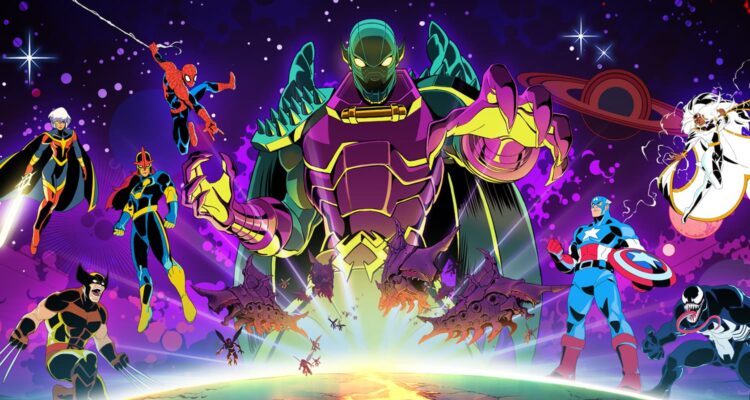
Many hours of my childhood and adolescence went into playing side-scrolling beat ‘em-ups, either alone or with friends. I couldn’t tell you how many times I played through my Super Nintendo cartridge of Captain America and the Avengers, often with my neighbour, or how many times I played the NES and SNES Teenage Mutant Ninja Turtles, Mighty Morphin’ Power Rangers and Spider-Man games. Then, there was the regular renting of Final Fight on top of all of that, and a good amount of time spent playing Marvel themed titles at the local movie theatre. Needless to say, I’ve liked this genre a lot for more than three decades.
When Teenage Mutant Ninja Turtles: Turtles in Time was remade for Xbox 360, I was in heaven. The same was true for the Scott Pilgrim game (especially the remaster) and Tribute Games’ phenomenal Teenage Mutant Ninja Turtles: Shredder’s Revenge, which I finished thoroughly on PlayStation 5 and Xbox Series. That game in particular was incredible and just what we needed. The recent Power Rangers one was no slouch either!
Now, the folks at Tribute Games and Dotemu are back with another anticipated licensed retro beat ‘em-up, with this one being Marvel Cosmic Invasion. It’s something I’ve been looking forward to playing, and can now talk about after seeing the credits roll just minutes ago.
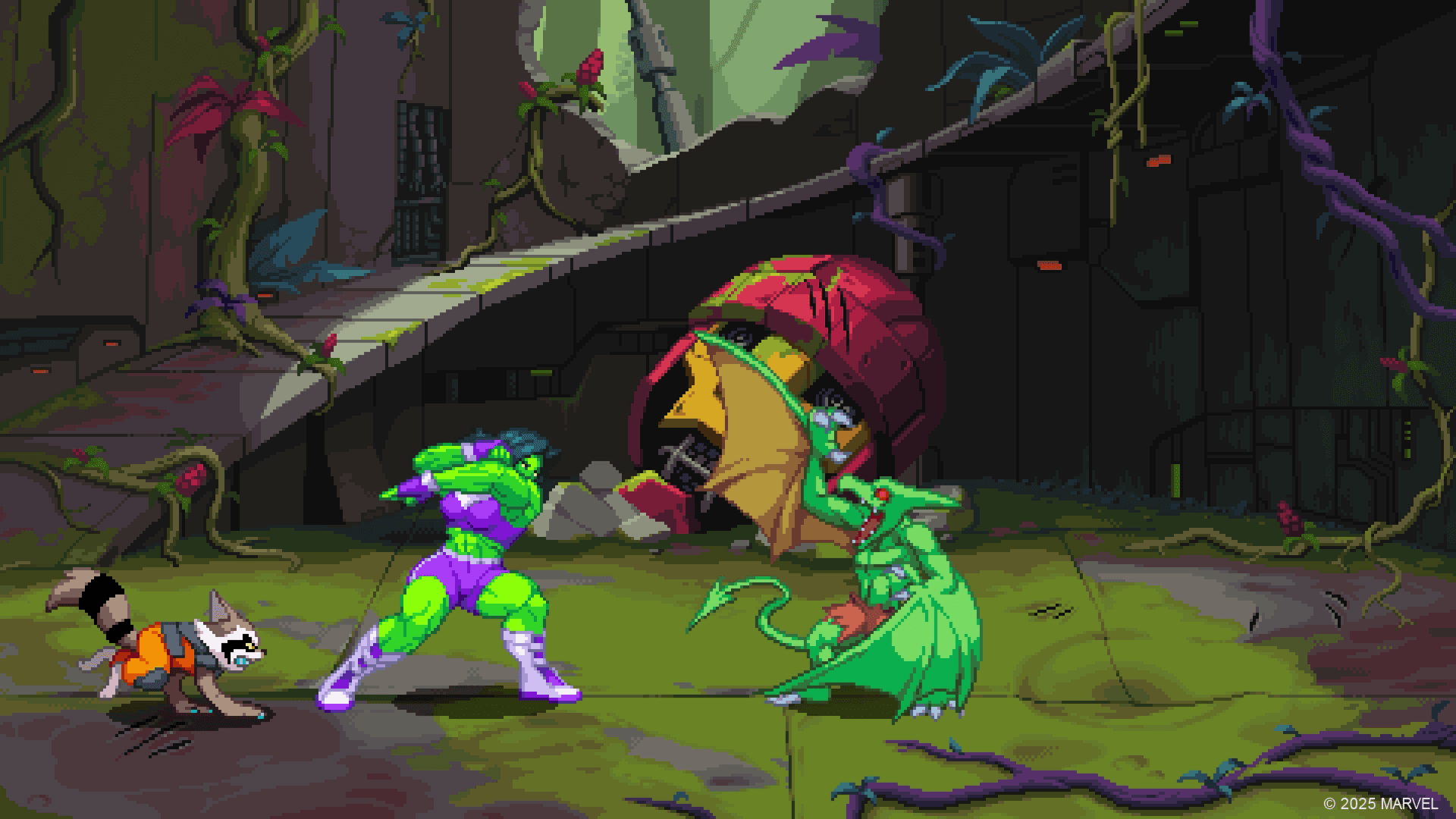
Bringing together a large roster of playable heroes, Marvel Cosmic Invasion is a new superhero tale filled with lots of punching, some colourful special moves and many dead enemies of varying types. It begins as a big bad named Annihilus (whom I’d never heard of before, despite being somewhat versed in Marvel) sets its sights on planet Earth. It kind of reminded me of the recent Fantastic Four movie, and it’s funny because this villain apparently comes from their lore.
It’s well known that these types of games use stories more for reason than substance or depth. That is pretty much the case with Marvel Cosmic Invasion, as the narrative can be disjoined as you jump from one realm, world or location to another, and do battle against various types of monsters, aliens, symbiotes, robots and human presenting soldiers. It doesn’t feel as cohesive as it could, but the result is an excuse to fight your way through a large part of the Marvel-verse, with a number of familiar bosses to boot. Each stage in the campaign features a boss battle, including ones against Venom, Silver Surfer, Thanos, and some that I couldn’t even name. The levels, themselves, aren’t too difficult, but the bosses can be choke points for lack of a better term.
While playing through this game, the one issue I had was with how uneven its difficulty was. I was never given a chance to pick the difficulty for my journey through its campaign mode, which was surprising. I’d do really well during the approximately 7-10 minute long levels, but would occasionally struggle against certain bosses. Venom was one of the hardest, but the final boss was rather absurd. I had to repeat certain stages more than once, and even more than twice at times, which is ok. However, the reasoning felt cheap.
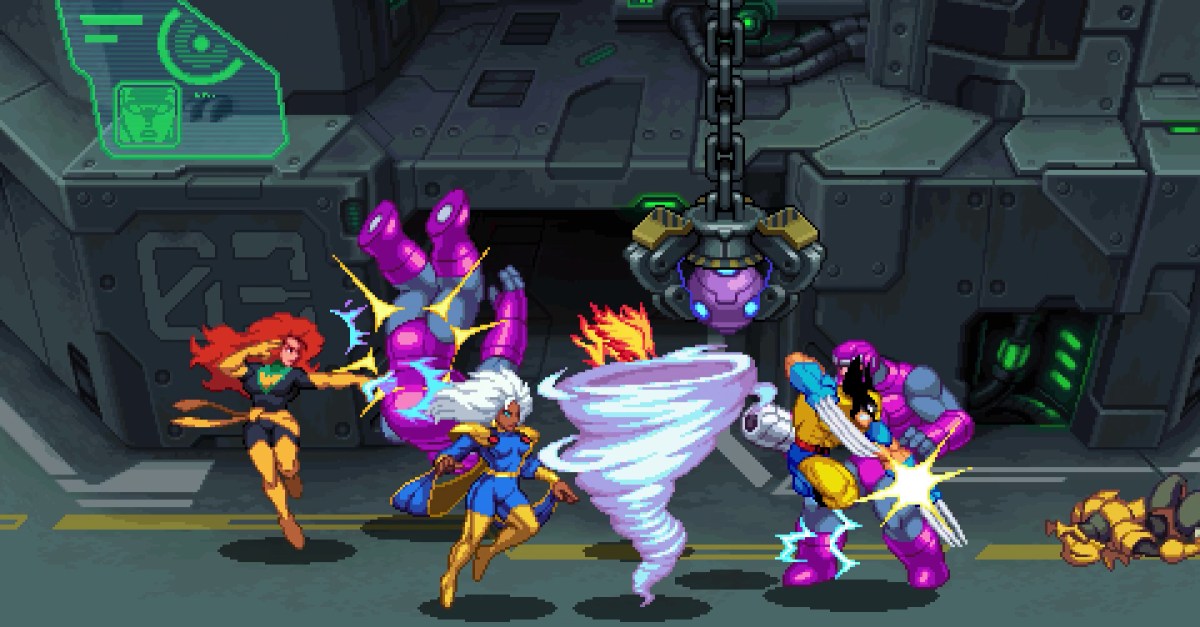
I get that some bosses will be more difficult than others, but two or three of them felt way more challenging.
I fought the final boss about three times, if not four, and the first attempts were with three other players in a party that I hosted. We got our asses handed to us the first time, and did better the second time, just for me to unexpectedly lose a lot of health as the final player standing. I thought I had him, but I didn’t. Then, when I finally beat him, it felt like he was a lot easier. I didn’t have much trouble, and didn’t even lose a hero. Someone else joined during the fight, which helped, but I’d had three others for two attempts and worried I’d never beat him or be able to say that I finished this game.
From checking out the customization options in the complementary, but separate, arcade mode, I’ve noticed that enemies can be scaled for one player or up to four. That makes sense, and means that it’s supposed to be more challenging with more players, though the stages often felt similar. That said, Venom was really hard and kind of cheap solo, and things never felt even. It’s all just inconsistent and kind of frustrating.
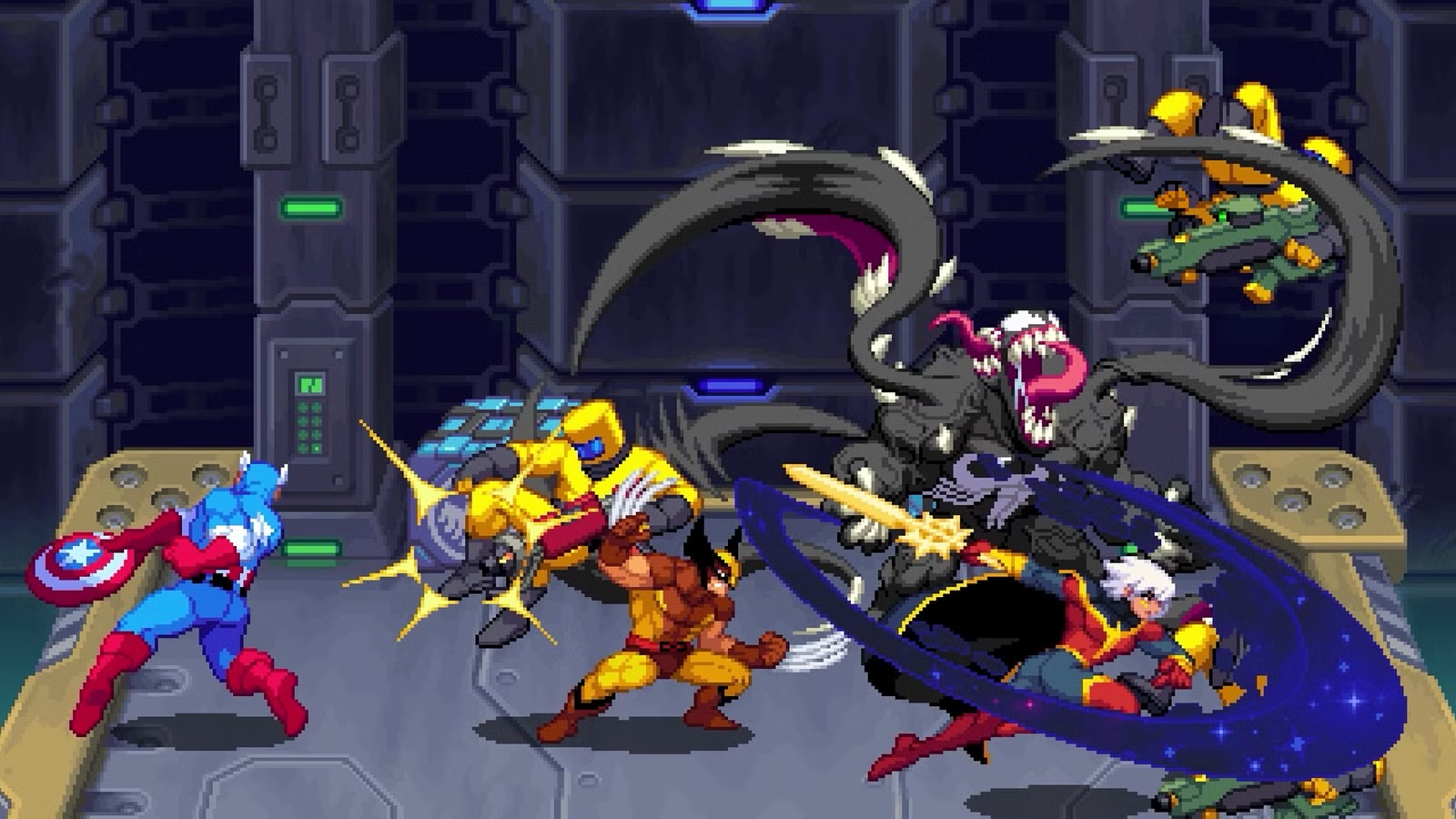
I truly feel that, due to this uneven difficulty level, as well as the fact that you can’t change the challenge level in campaign mode, certain people will feel alienated or give up. This isn’t as accessible as previous games in this genre, including Teenage Mutant Ninja Turtles: Shredder’s Revenge. It’s also not like Scott Pilgrim, where you keep playing until you buy upgrades and the game ends up becoming a cakewalk. While sticking with the same characters does have its benefits, including levelling them up, receiving upgrades and improving their health, it doesn’t feel like too much overall.
That’s another questionable thing about this game; that being the fact that you can level up individual heroes, although it presents you with a roster of fifteen and wants you to experiment. There are pros and cons to this, but I’m on the fence about it. I’m glad that I was able to improve Wolverine, Spider-Man and Venom, whom I mained, but I feel that I missed out on not experimenting with other characters later on. I did at first, but then mostly stuck with old favourites that I’d upgraded later on. Venom is kind of an exception, but he upgraded fast, likely due to repeating stages.
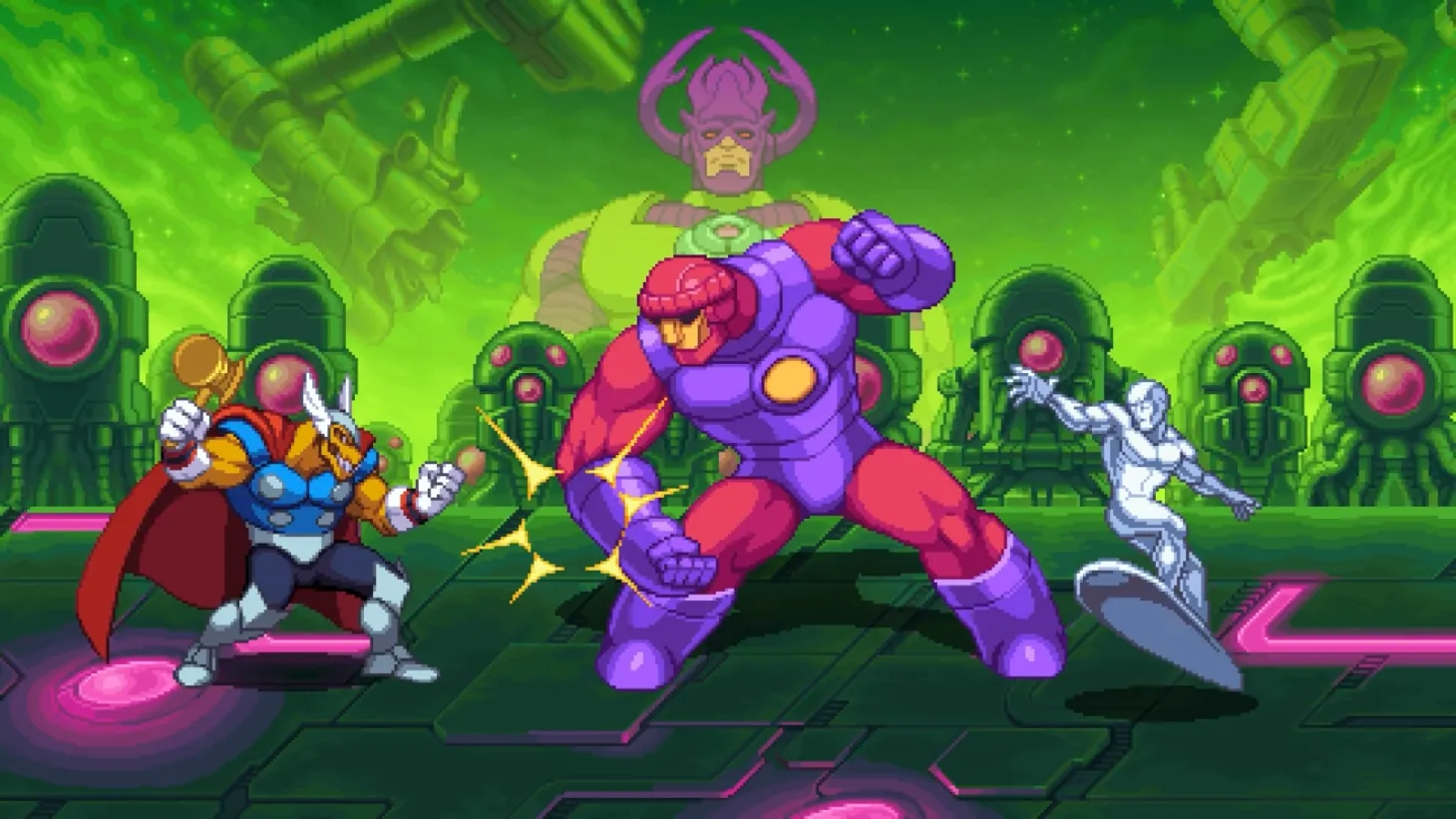
Maybe the game would have been a bit easier had I used less melee focused characters. Next time, I’d probably use Ghost Rider, who seems like a real badass after quickly trying him and some others out in arcade mode. Having a ranged attack to use would be nice.
I got off on a bit of a tangent there. Sorry about that. Let’s get back to basics.
As I mentioned above, Marvel Cosmic Invasion is a four player retro beat ‘em-up, meaning it’s like a modern day Super Nintendo game. It differs from its peers, though, because it allows you to pick a tag team of two characters per stage. Yes, there are recommended heroes for each one, based on story, cutscene and dialogue reasons, but you don’t have to go that route. You can use the same two all game, or mix things up by choosing any of the other 15 roster members. However, you’ll have to unlock some of them through natural progression.
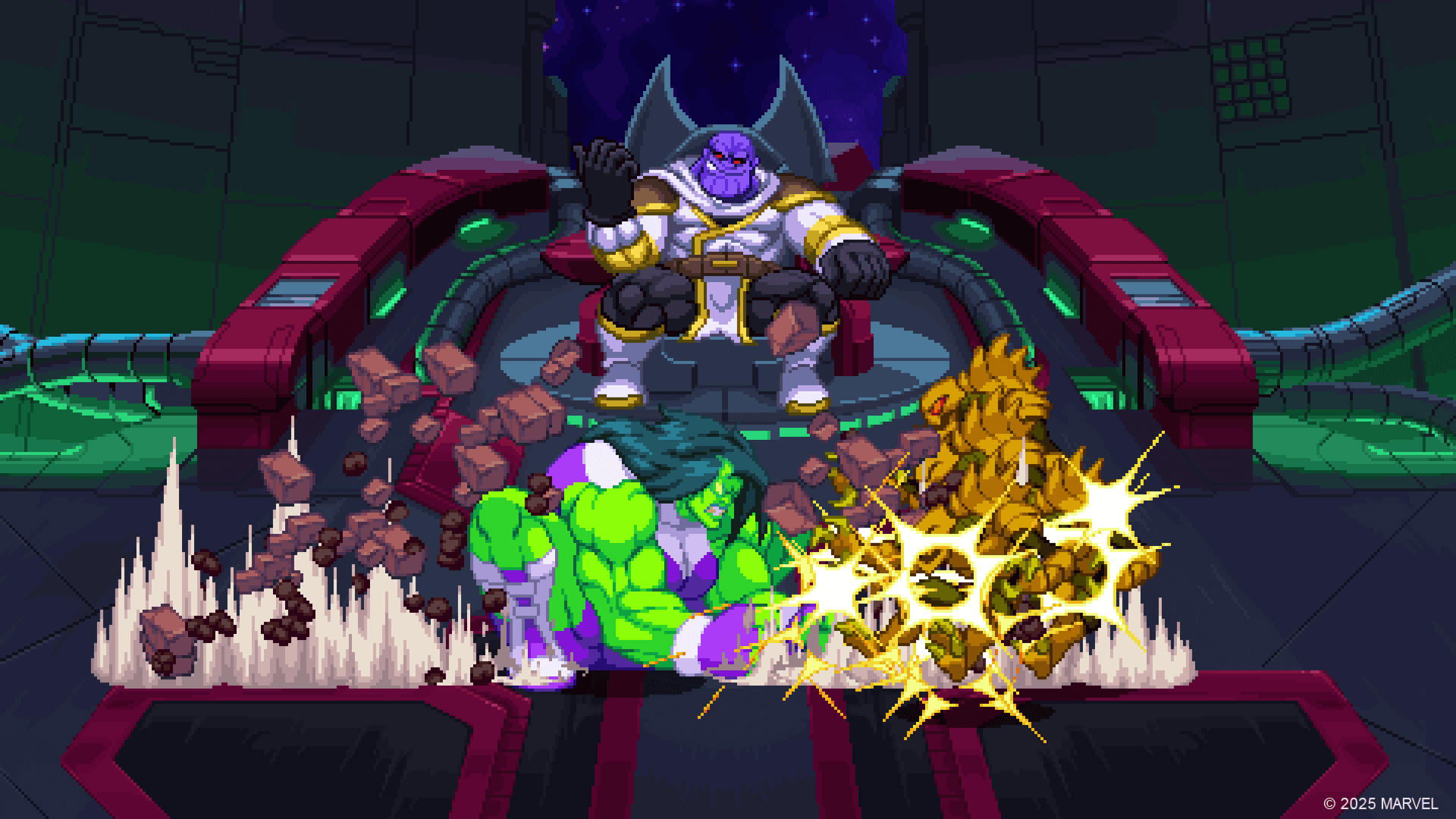
The roster includes iconic Marvel superheroes and villains, as well as some I didn’t know anything about. There’s Wolverine, Spider-Man, Captain America, Storm, Black Panther, Phoenix, Venom and Iron Man. Then, there’s also lesser characters like Silver Surfer, Beta-Ray Bill, Cosmic Ghost Rider, Nova, Phyla-Vell, She-Hulk and Rocket Raccoon. There’s a nice mixture, and all of the above have their own skills, along with pros and cons. After all, as is the case with almost any game of this ilk, every playable character has his or her own type of basic attack, grab or heavy attack, and special ability; the latter of which can only be used occasionally, but can be very helpful. They also differ when it comes to being dodge or block characters, with blockers being able to parry if done perfectly. I must admit, though, that I only parried once by accident, and often forgot all about blocking or dodging. There’s so much going on, and I’m just not used to it.
As you’d expect, some of the aforementioned characters can fly, which is helpful. Others need to jump over gaps or obstacles, and must also do so to attack flying enemies. Spider-Man and Venom can swing, and the former can also do a swinging kick move from one side to the other. That was one of my favourite abilities.
Each of your two heroes can be changed at will, but if one dies then they’re out of commission for the rest of that stage. When both die, it’s game over. You’ll have to go back and restart the level from the beginning. Thankfully, they aren’t long.
It’s also possible to call in your second for an assist. They’ll briefly help you, and then go back into hiding. This dual system also comes into play when one hero is being held by an enemy. It doesn’t happen too often, though.
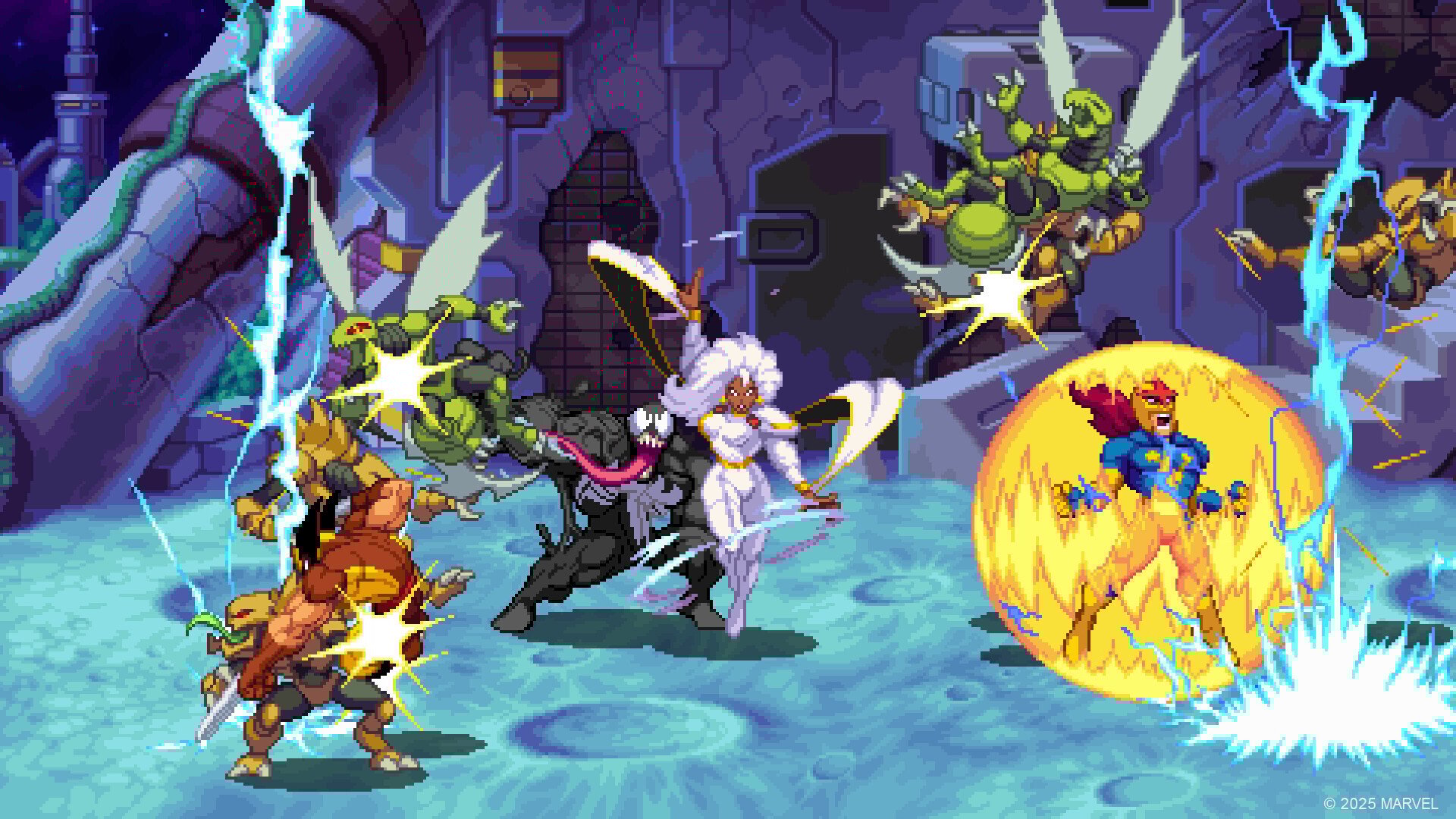
The core combat is fun and addicting, and it’s fast too. When multiple players are taking part in the same stage, things can get really chaotic, and it can be easy to lose track of your avatar with everything going on. It’s just what happens with so much happening on screen. The game handles it all very well, and is both fluid and polished despite being fast and having so many unique character animations going on.
Playing through things unlocks tokens, which can then be spent in a shop of sorts. Basically, there’s a shaped grid, and you use your tokens to unlock different squares within it. The prizes take the form of new music, character colour palettes, character files (information about them), arcade mode modifiers, and more. It’s nothing too special, but it adds to the experience. The same is true of the level specific challenges, of which there are three. These task you with beating a boss with a certain hero, not getting hit during a segment, and things like that.
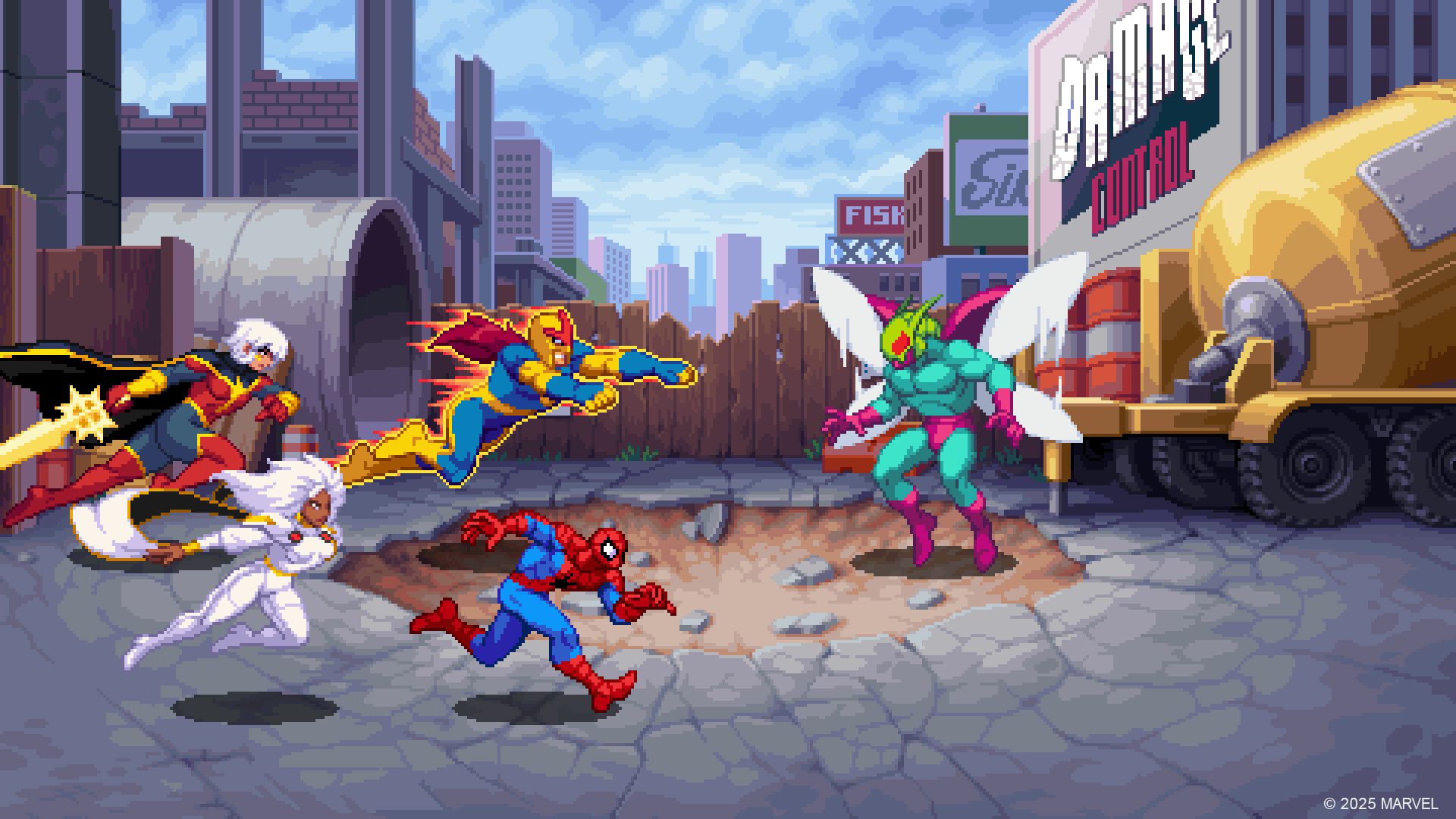
As expected, Marvel Cosmic Invasion is a retro styled brawler, meaning it’s been designed to look like a modern take on a Super Nintendo game. There are CRT overlays you can use, but I didn’t bother after quickly testing each one. It’s a beautiful game, though, and made me think of better times. The animations are fantastic, the characters and enemies all look great, and so do the stages. Each one is different, and they’re all themed. The most interesting of the bunch is probably the Asgard stage, which begins with the rainbow road. The effects make it look like it’s coming at you, like a Guitar Hero song board, and you fight foes along it.
The only glitch I experienced during my six hours with this thing pertained to one enemy that I couldn’t hit. I was eventually able to end its digital life, but it seemed to be by luck. Outside of that, the only technical flaw I noticed was a brief black screen before a couple missions. It seemed like it may have frozen the first time, but it was likely because both of the additional players (who were connected via the internet, and possibly through cross-play, as opposed to the possible local option) had disconnected.
Depth perception can be an issue, though, as it can sometimes be hard to tell exactly where an enemy is located on screen. There were a number of occasions where I thought I was going to jump attack a flying foe just to end up missing them.
Conversely, the audio can be a bit hit and miss. There’s nothing wrong with it, but the voice acting isn’t the best at times. The same is true of the narration. However, given the type of game this is it’s a lot easier to understand and forgive. Not that it’s bad. Of course, there’s also fitting music in the style that some of us grew up with in the 80s and 90s.
At times, certain characters will break the fourth wall and point out the amount of cameos in a stage, the great looking pixel art or things like that. Some will like this, and some won’t. There’s also some questionable dialogue, like She-Hulk continually commenting on the attractiveness of some beefcake in the nature realm. I think it was called the Savage Lands.
I’m admittedly not as big of a Marvel fan as I am a Teenage Mutant Ninja Turtles fan. I grew up with both of them, but the Heroes in a Half Shell were a much bigger part of my early years. I’m also very sick of superhero movies and TV shows from any company, but that’s nothing new. However, with that being said, I would love more superhero games. These are much more interesting than the movies.
Due to the above, and the fact that I started my gaming life with the Turtles games on the original NES (damn that underwater stage), I was more excited for Shredder’s Revenge. I was still quite excited for this one, though, and considered it to be one of my most anticipated of the year. However, I didn’t enjoy it as much as Tribute’s previous effort. Cosmic Invasion is a really good game, but it’s not a masterpiece like Shredder’s Revenge was. Inconsistent difficulty issues, and a bit of a disjointed story, keep it from achieving the same heights.
Overall, though, Marvel Cosmic Invasion is a high quality beat ‘em-up, and one that should appeal to others who grew up during the 16 bit heyday of the 90s, or simply miss that time. It’s another strong effort from a very talented developer, and one that should not be missed.
This review is based on the Xbox Series X version of the game, which we were provided with.