

If you have kids, then you’re likely aware of the global phenomenon that is Bluey. If not, it’s a children’s TV show that — if I remember correctly — was said to be the most streamed thing in the past year. Hell, my friend’s daughter leaves it on for her husky while she’s out.
Set in Brisbane, Australia, Bluey is an animated show about a blue heeler puppy and her family, including her sister, Bingo, and her parents, Chilli and Bandit. Together, they go on imaginary adventures, featuring made up games and imaginary play meant to stimulate kids’ minds. The show focuses on play, creativity, modern parenting and emotional intelligence.
Although there was a relatively basic tie-in game released a few years ago, it didn’t have all hands on deck. Fast-forward to the present, and we now have another game based on the show to talk about, and it’s one that was crafted with the help of its creator, Joe Brumm, who wrote the story. As such, it’s more noteworthy, and is also more involved and in depth than its predecessor. It’s also better.
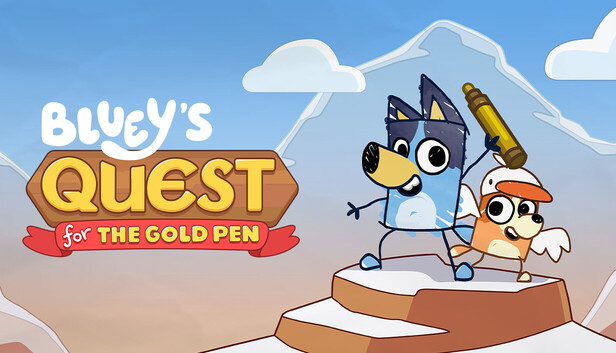
Entitled Bluey and the Quest for the Gold Pen, this new release from Joe Brumm and Halfbrick Studios (Fruit Ninja) originally released for mobile planforms at the end of 2025. Now, several months later, it’s available for consoles. We were provided with a review code for the Xbox Series version, and can now share our thoughts after playing through it.
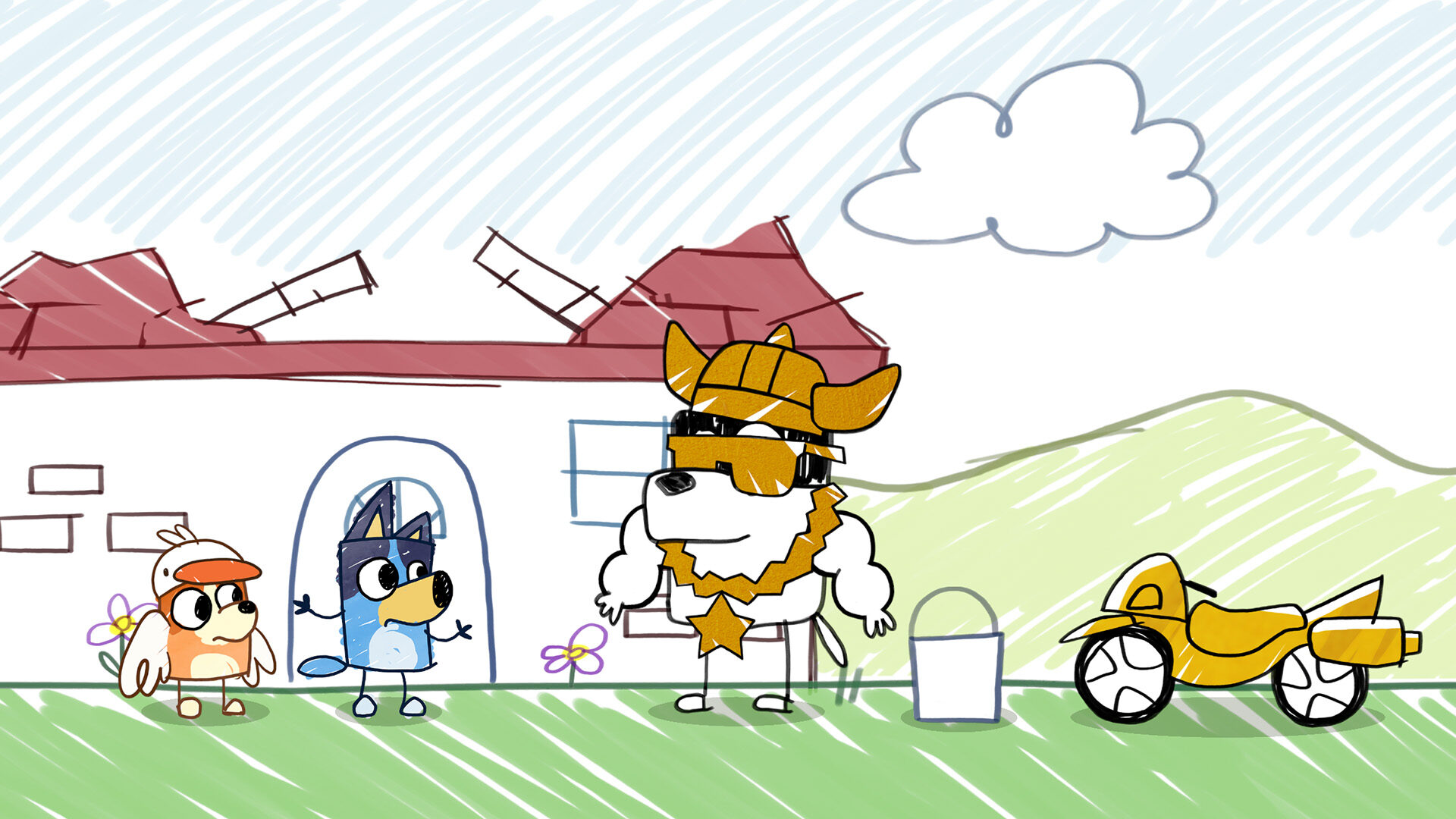
Things begin in the family’s well known kitchen, where they happen to all be sitting around the table. Using their imaginations, they dream up a story about Bluey and her sister, who’s transformed into a Bingoose, being on a quest. To further their quest, they need to create a golden egg. There’s a problem, though, because they don’t have the golden pen to draw said egg with. Bluey’s father, Bandit, has that one and isn’t interested in giving it up. Instead, he turns himself into a gold covered bad guy, who won’t give the pen away because he’s too busy drawing his golden castle with it. He then sends his daughters’ hand drawn heroines on a quest through made up regions, to keep them busy while he draws, much to their mother’s chagrin.
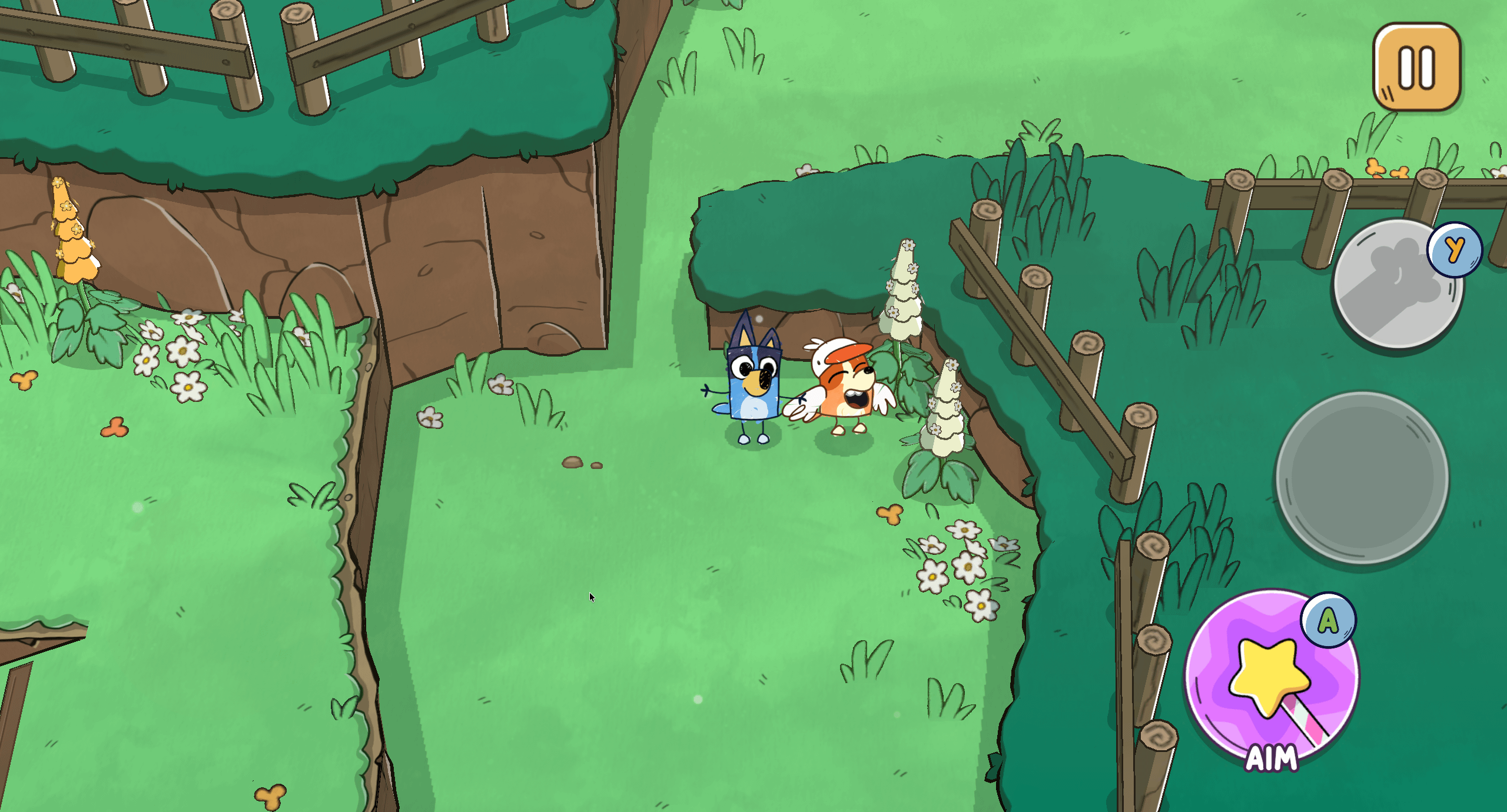
Presented like an old school, top down, Zelda game, Bluey’s Quest for the Gold Pen is a combat free experience. Players will control Bluey and Bingoose (in single player fashion), as they navigate through different, contained, regions, such as a meadow, a forest, a cliffside, a large beach, an abandoned mine, a sky kingdom and more. Your goal while exploring these relatively large areas is to collect different types of goose food, which is usually presented as different types of fruits and vegetables, like carrots, grapes and strawberries. When you collect enough (say 8-10 pieces of goose food), you can be transported to the exit of said area, where some sort of creature (a golden bird, a golden penguin and more) is blocking the way until it’s given something it wants. At that point, players can feed Bingoose the required amount of food to make her lay a silver egg, which contains whatever that creature wants. Then, one can move on to the next cutscene, and the next region after that.
If you don’t want to stop the fun, it’s possible to continue exploring each region to your heart’s desire. This is important to mention, because there’s more goose food in each location that what you actually need. You may need only ten pieces, but there could be twenty-five to find. That gives kids multiple ways to reach their goal, and can help prevent them from becoming stuck. The same is true of fast travel points, which can be activated and used through a map system that uses the old A Link to the Past system of presenting unexplored areas as being clouded over. Since one area can have a few different parts to its map, be they accessible by mine cart or something else, this is very helpful. What’s also helpful is the fact that the developers highlighted important non-player characters on said maps.
How do you earn all these pieces of goose food? Well, there’s more than one way.
Every region you’ll visit has its own quests, if you’d like to call them that, but some are constant no matter where you are. For instance, each location has its own form of collectible currency (beads, purple things, etc.) that can be collected by digging in designated areas or walking over closed flowers, before being turned in to NPCs. Each one also features its own type of collectible creatures, which one must find around eight of in order to earn a goose food reward. These include beatles, caterpillars, frozen butterflies, ants and ladybugs. On top of that, there’s always one quiz loving NPC who’ll ask you a question about that region.
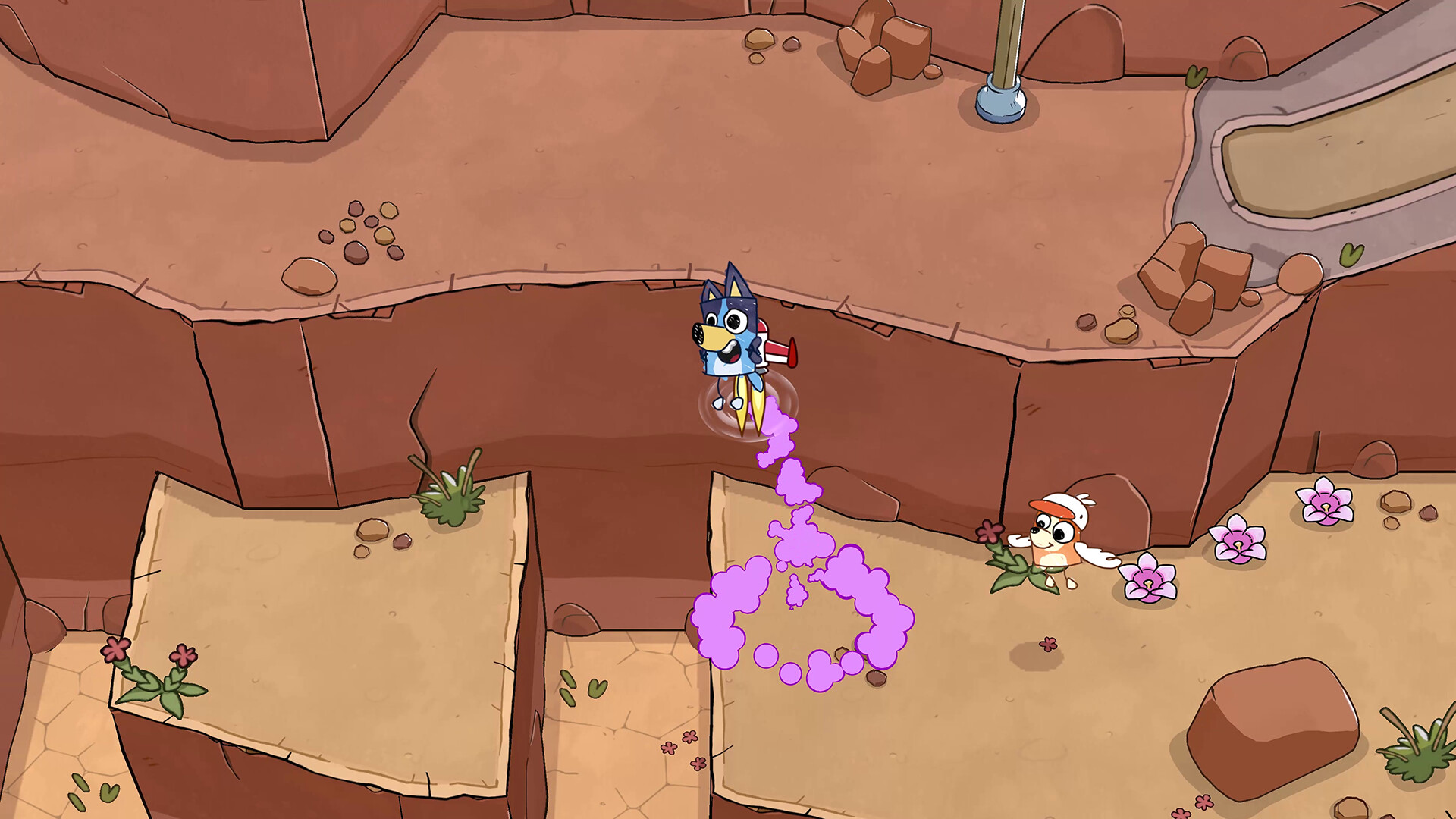
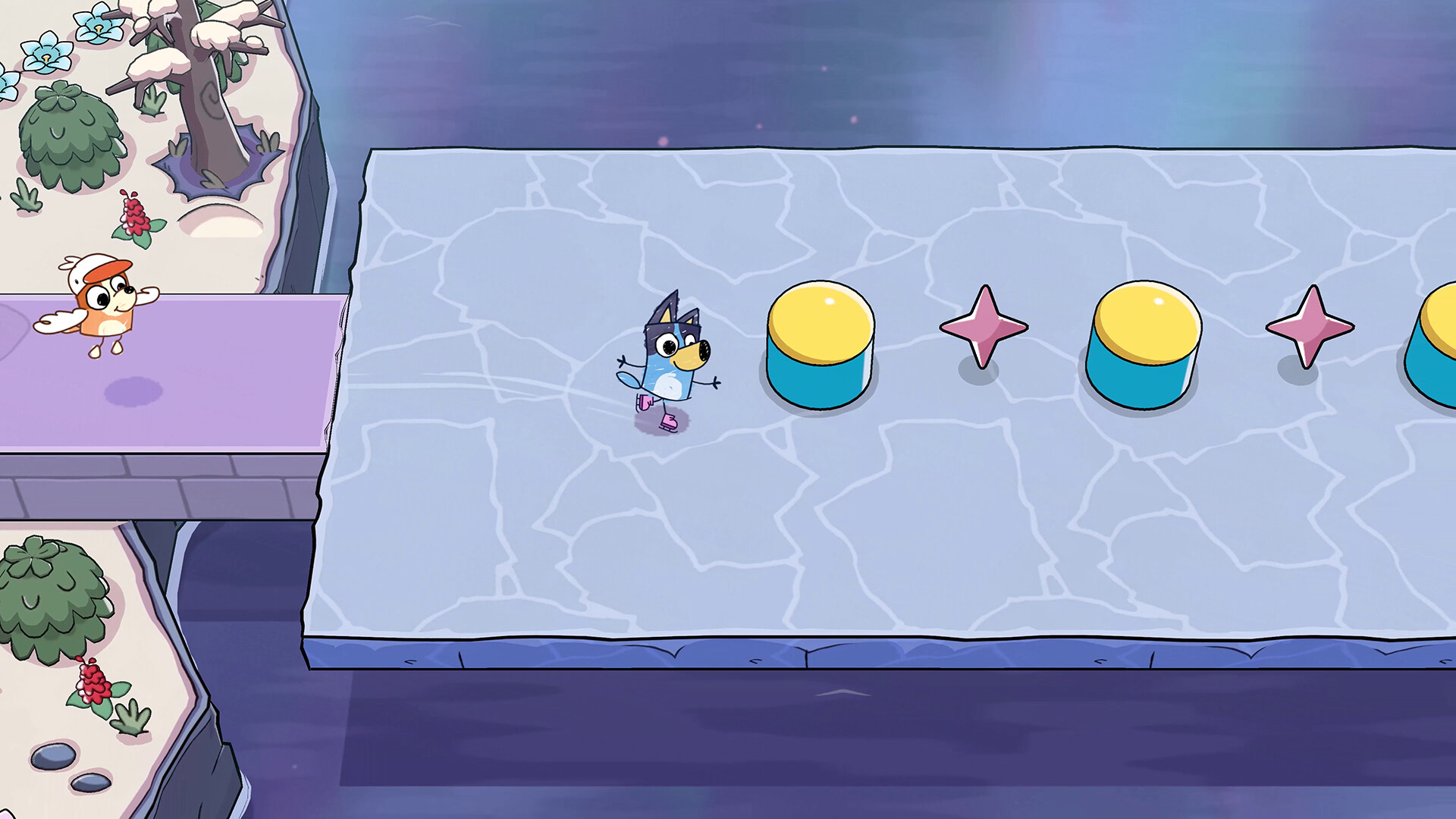
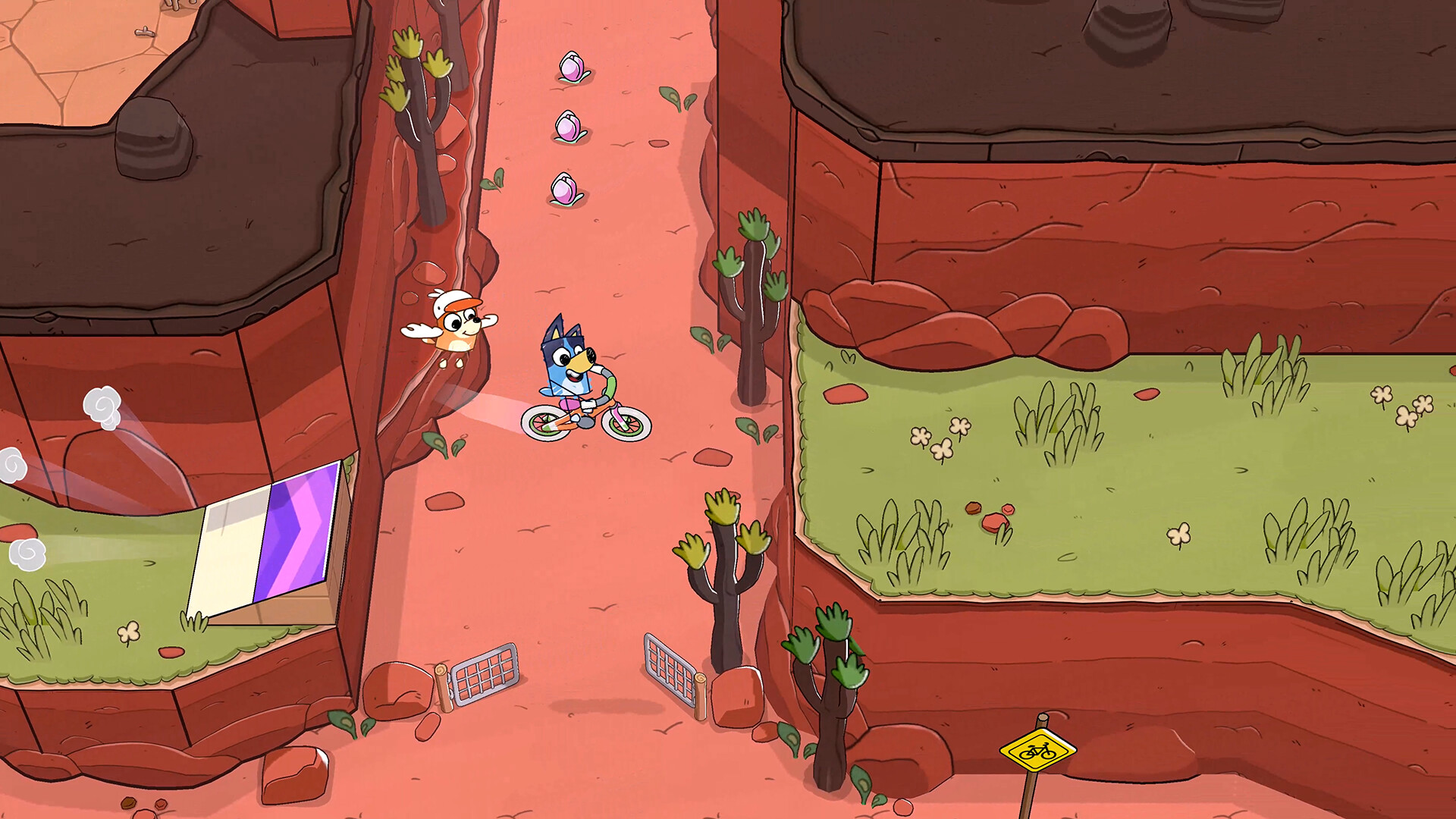
Bluey has a magic wand, which can shoot out starry projectiles, and those can be used to break blocks. The wand can also be used to move golden platforms in order to reposition them and solve light puzzles. You’ll do this in order to reach pieces of goose food that are sprinkled throughout each region. Later on, you’ll need to use different types of gadgets, or a vehicle, in order to collect these. Those include a glider, which lets you float over gaps, a jetpack that lets you reach higher platforms, and a bicycle (in the outback map), which allows for both faster traversal and the ability to go over jumps containing speed boosts. Furthermore, when you play as Bingoose, you will also be able to briefly fly and dash ahead, or up ramps. Plus, at certain points, Bluey can also skate on ice, and jump to reach higher platforms, which I didn’t realize at first because jumping wasn’t an option otherwise.
I collected most of the required goose food by completing these platform puzzles, a lot of which involved moving blocks, hitting switches to create timed platforms, using the wand to latch onto star posts and pull Bluey across, or dealing with platforms that break quickly after being stepped on. Many began by going up a ramp, picking up a star and then trying to collect all of the mini stars that it spawned before time ran out.
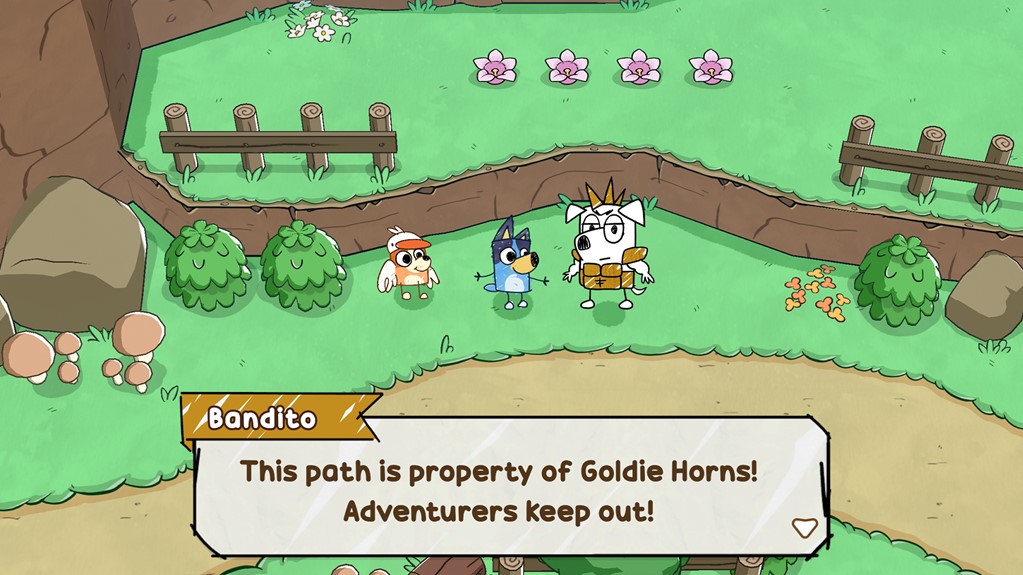
Needless to say, this is pretty routine stuff for games of this ilk. Bluey and the Quest for the Gold Pen doesn’t reinvent the wheel with its platform challenges, basic quests, collecting, light puzzles and its memory challenges, the latter of which involve talking to NPCs for clues to a code or password needed to unlock something. It’s difficult enough to make one think, but is not all that challenging, given its target audience of young kids and maybe their parents. That said, a few of the puzzles may be challenging for the youngest gamers among us. Although this is a kids game, it doesn’t talk down to its audience, and a couple sections took me a couple of tries, due to falling off a platform or something like that. There was also a time where I got lost, but it didn’t take long to figure out where I needed to go.
At the start, I was trying to collect every possible piece of goose food, even though I didn’t need to. However, as the game continued, I started to get a bit tired of the formula and the repetition. After all, despite the obvious effort that went into making a quality game that was not phoned in or rushed to make money like tie-in games used to be, this is a repetitive and relatively basic experience that began life as a mobile game. After a while, things got to be very similar, but it only took me 3-4 hours to complete the game. Of course, I could have finished it sooner, had it not been for the completionist inside me.
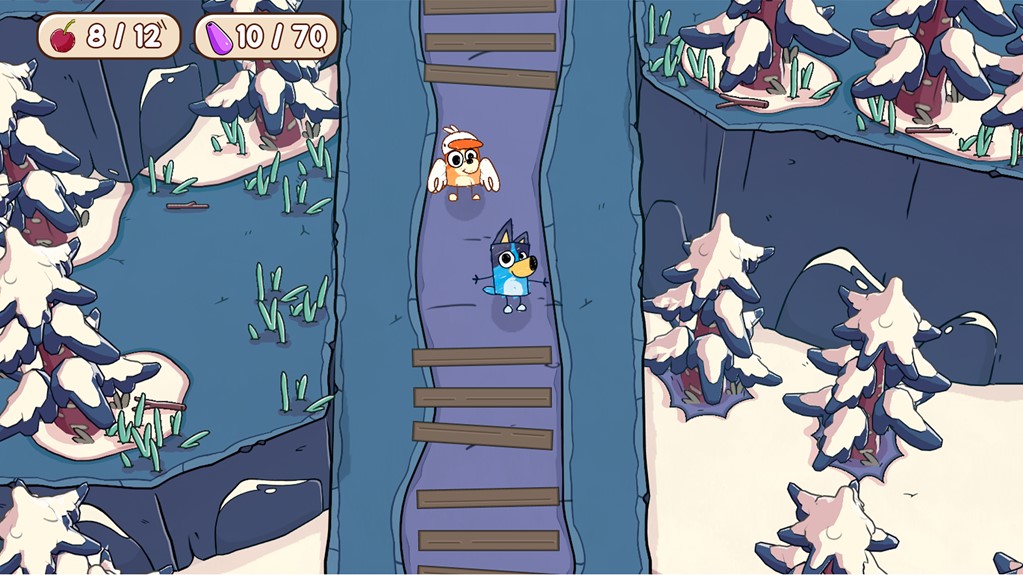
As mentioned above, Bluey and the Quest for the Gold Pen was first released onto mobile devices, beginning with iOS. This would be pretty obvious to most gamers, because the console version of the game still features the touch screen icons that show you which tools and abilities you have at your disposal. These reside in circles on the right-hand side of the screen. I’m not sure why, but there was also another purple circle that kept showing up on the left side, but never featured anything. At times, it seemed like part of the visual design of certain levels, or parts of them, but it was there a lot, and made me worry about burn in.
Of course, this title features the show’s art style, especially in its cutscenes, which are fully animated and voiced, presumably by the actors who portray those characters on TV. There’s also a lot of hand drawn characters, environments and basic animations featured in the actual game environments, which players must explore and interact with. It’s all very colourful, and looks both nice and fitting.
The music, on the other hand, shocked me. It’s surprisingly good, and wasn’t phoned in at all. With such a game, it would be easy to have just included some basic chip tunes or something simple, but that isn’t the case. I actually quite liked some of the noticeable, and quality, music found within this one.
With all that being said, I doubt I need to say that I liked Bluey and the Quest for the Gold Pen, as I’d hoped to when I first started covering it through news posts. It’s a game for a younger audience that was made with love and care, and wasn’t rushed in order to make money off of its IP, which I respect. It does get really repetitive, and is something that older gamers like myself will reach the ceiling of quickly, but it’s not made for us. Although I would have liked more variety, it’s a good game and something that fans of the show should truly enjoy.
This review is based on the Xbox Series X version of the game, which we were provided.