

Growing up during a time when arcade games were still somewhat prevalent and popular meant being able to enjoy numerous different types of games in that format. Although I truly enjoyed playing beat ‘em-ups, racing games, light shooters, Gauntlet Legends and NFL Blitz this way, it was also the optimal way to play fighting games. Taking on friends at the local Cineplex, or battling the computer on the Street Fighter 2 cabinet at my uncle’s convenience store was always fun.
Back then, I enjoyed playing different fighting games, including buying and renting random ones (like Mace: The Dark Age for N64), and playing the Mortal Kombat trilogy at a friend’s when he had this directional combat accessory for his Sega Genesis. These days, I don’t honestly have much interest in the genre. It’s mostly disappeared. As such, I tend to get bored of the fighting games I’ve played and borrowed from the library, including recent entries in the most popular series. They’ve stopped being for me, and I’ve lost touch with the genre. This needs to be said, as I want to be clear that this review is coming from someone who’s had experience with these types of titles, but lost interest in them over the last decade or so. I am not an expert or a super fan, so please know and maybe forgive that.
When Marvel Tokon: Fighting Souls first started being shown, it looked like a beautiful genre effort and piqued my curiosity some. However, I still wasn’t sure if I would play it, because of the reasons mentioned above. When I received a surprise review code for the game, I was appreciative and looked forward to trying it, but was also worried that I wouldn’t be able to do it justice by review.
Surprisingly, I’ve truly enjoyed my time with Marvel Tokon: Fighting Souls. It’s a fighting game that I actually enjoy, and it’s made me remember why I used to like these as a kid and teen. It’s a very good release, and one that is truly fun and impressive, to the point where it was hard to put down.
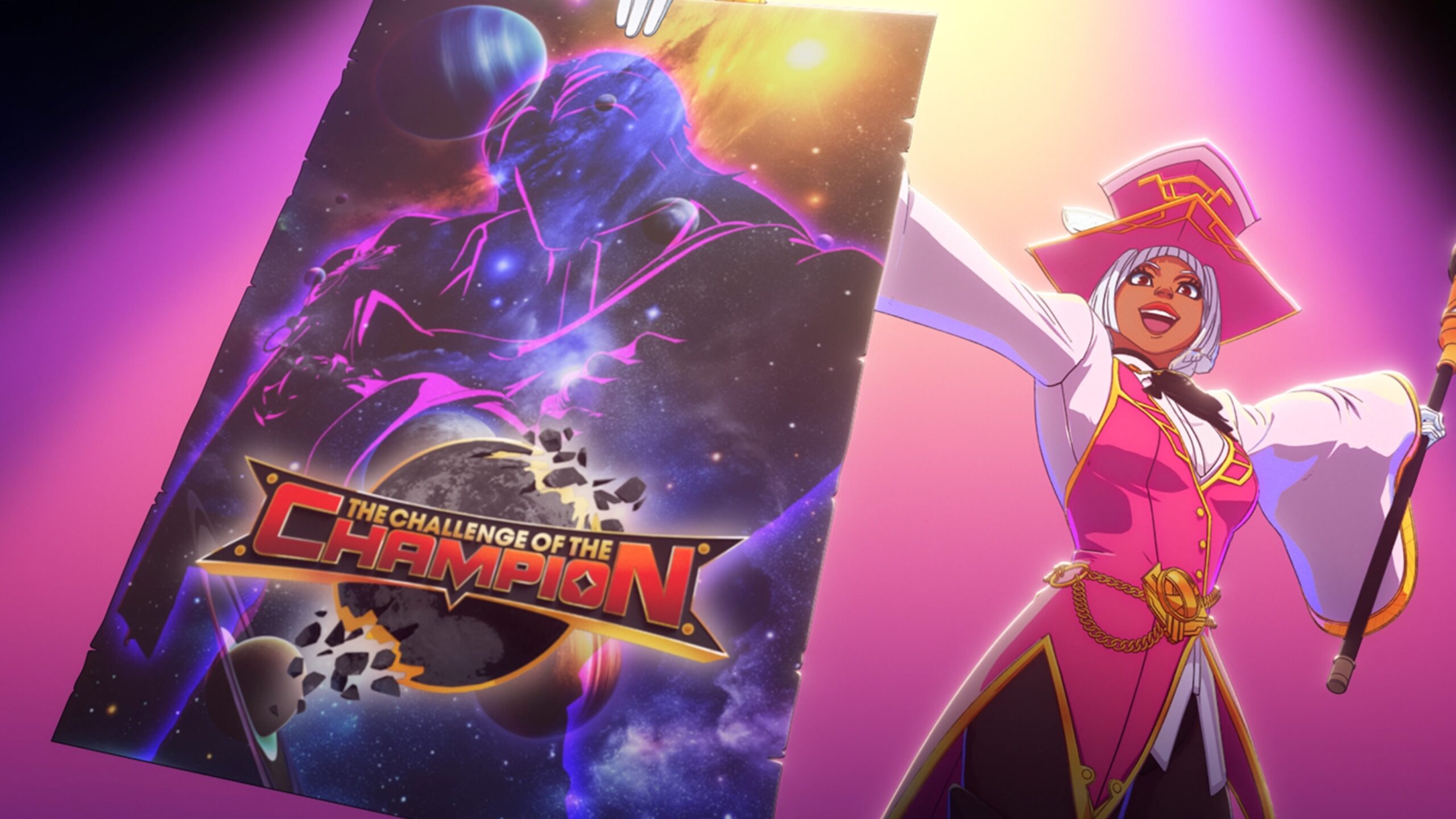
The set-up involves an almost forgotten Marvel villain called the Champion, who sets his sights on our green and blue planet after laying waste to others in bouts of disappointment. That’s because the Champion’s goal is to do battle against the citizens of the planets he visits, in the hope that he will one day find ones worthy of living. To set all of this up, he sends his vaudevillian employee, The Promoter, down to organize the tournaments. In her very colourful and exuberant way, she appears before the best and most powerful heroes of each planet and presents them with letters informing them that they’ve been chosen. Well, she does this with the leaders of each team, at least.
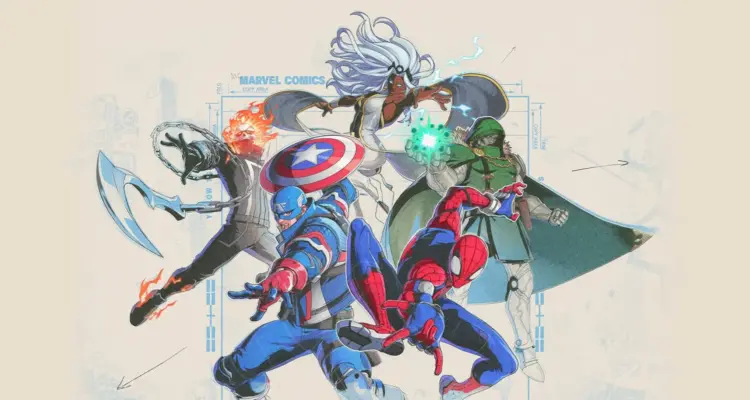
While the previous planet got to send teams of one hundred against the Champion, Earth only gets to send groups of four. The leaders of these (several) different teams end up being Marvel heroes and villains, and the result is an interesting selection. They are, as follows:
The Fighting Avengers: Captain America, Hulk, Iron Man and (the female) Black Panther
The Unbreakable X-Men: Storm, Wolverine, Magik and Danger
The Samurai Outriders: Ghost Rider, Blade, Deadpool and Loki
The Knights of Doom: Doctor Doom, Magneto, Carnage and Green Goblin
The Amazing Guardians: Spider-Man, Star-Lord, Peni Parker and Ms. Marvel
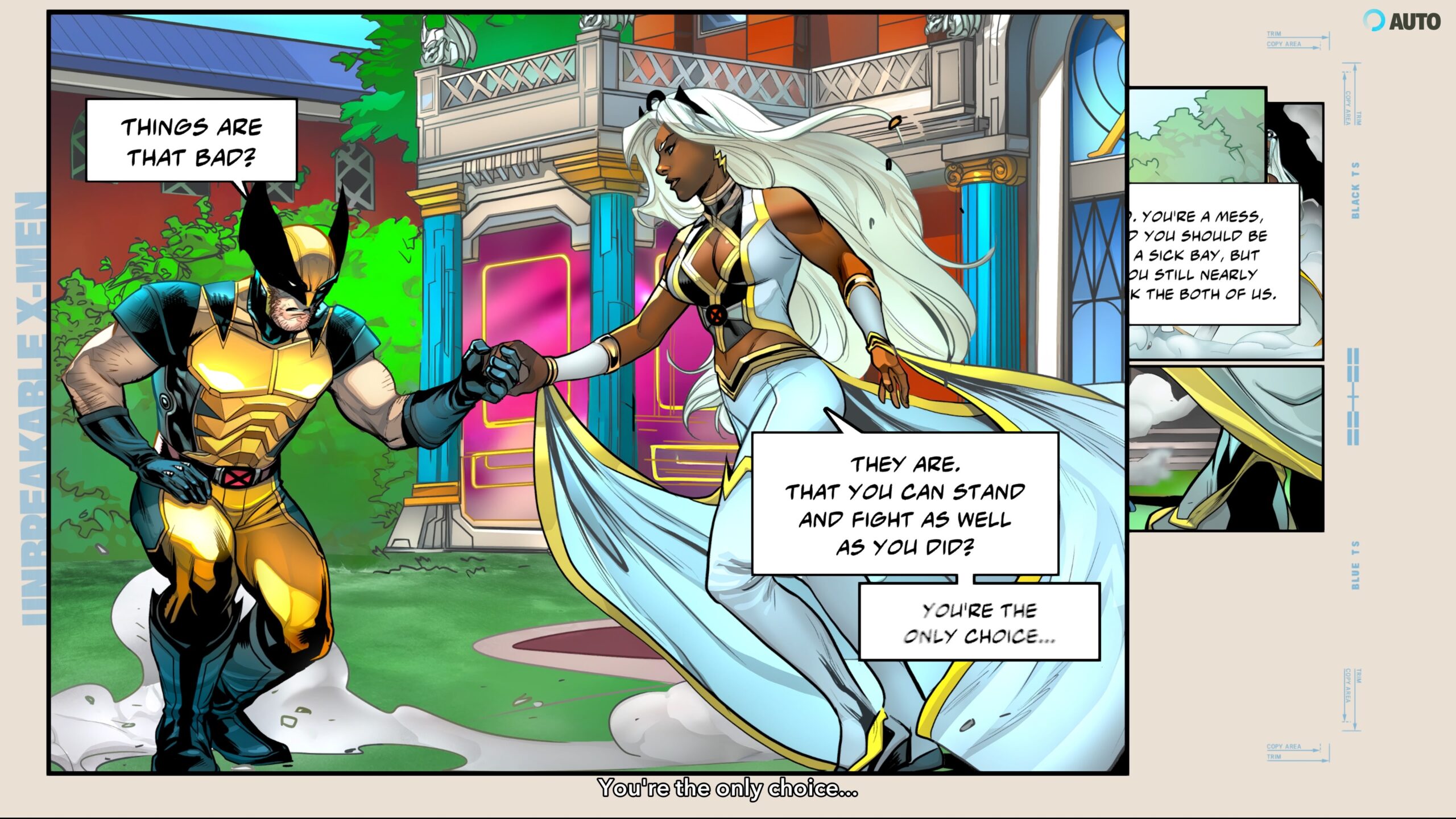
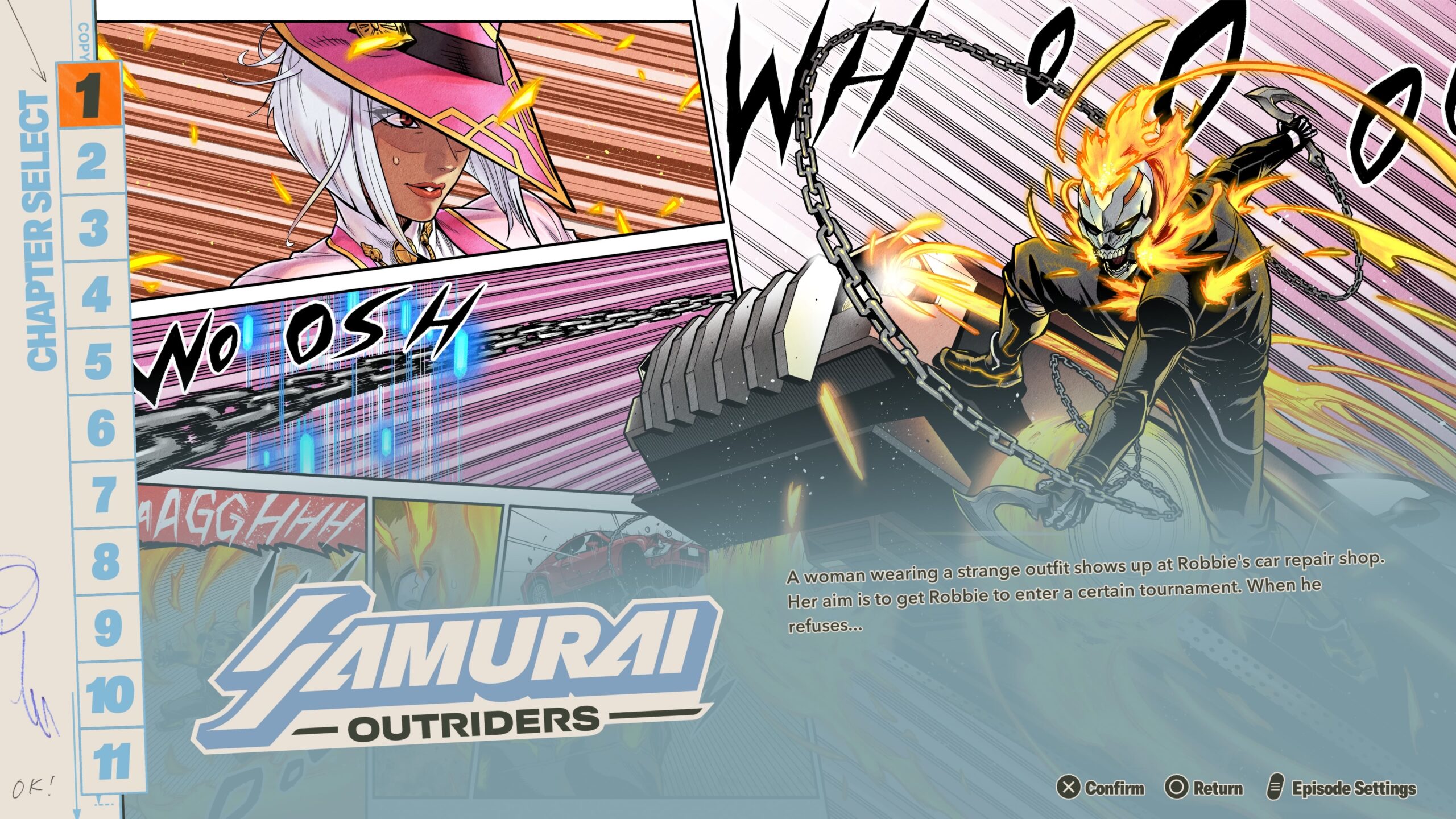
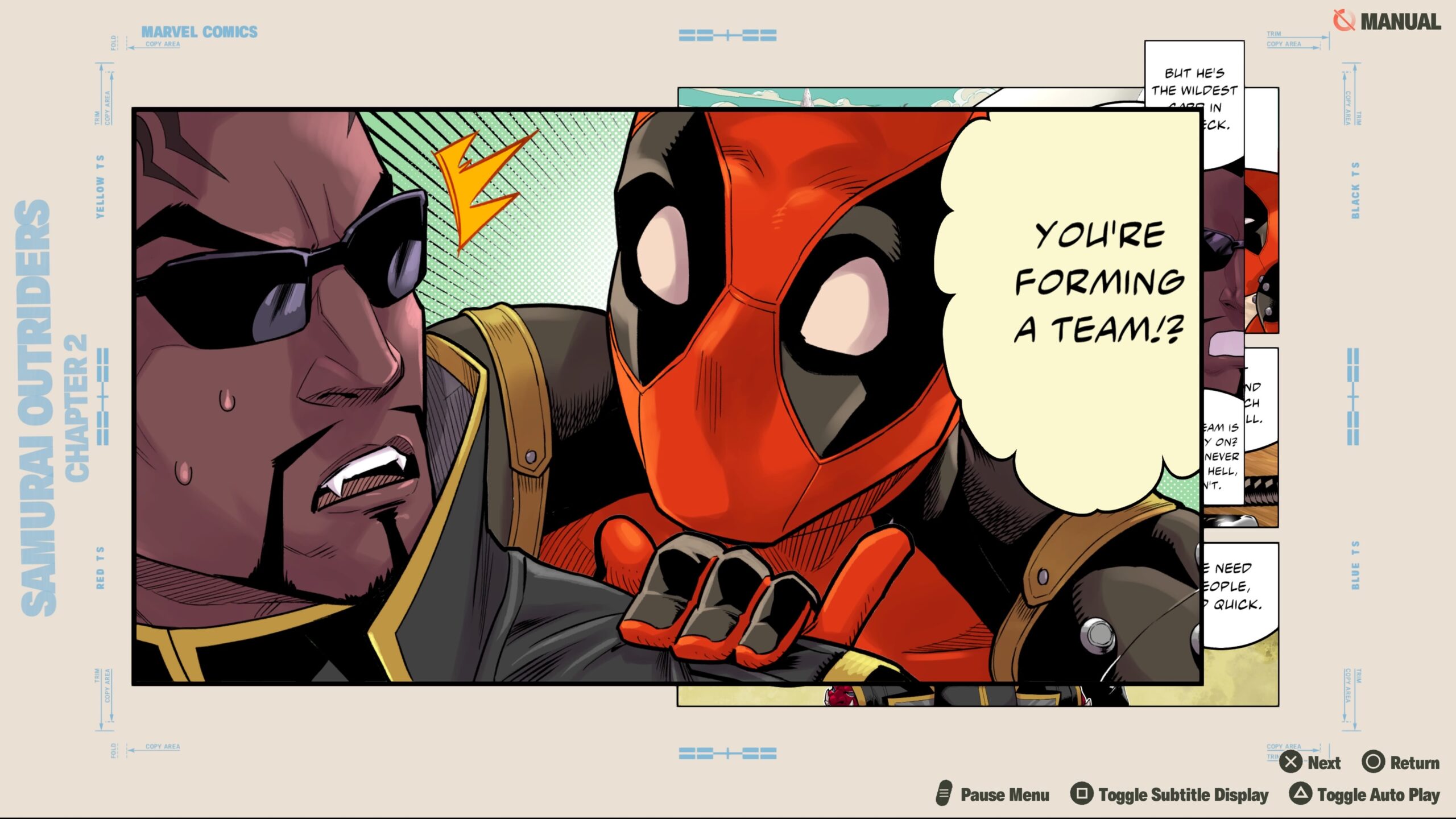
These five teams make up most of the competitors found within this game’s story mode, which is separated into five different stories — one for each. The idea is that you play through each one, and experience each team’s individual origin, their motivations and what happens to them; most of which is told through moving comic panels with voice acting. In each team’s story, they’re the potential heroes. However, they’ll have to win against the others in tournament form, and sometimes even against eachother.
For the most part, these story chapters (which are maybe an hour-and-a-half long, and are made up of approximately eleven acts) are fun, interesting and enjoyable. However, they can be quite wordy, and do become formulaic. Those things didn’t bother me much, though, and I’ve had fun playing through them all.
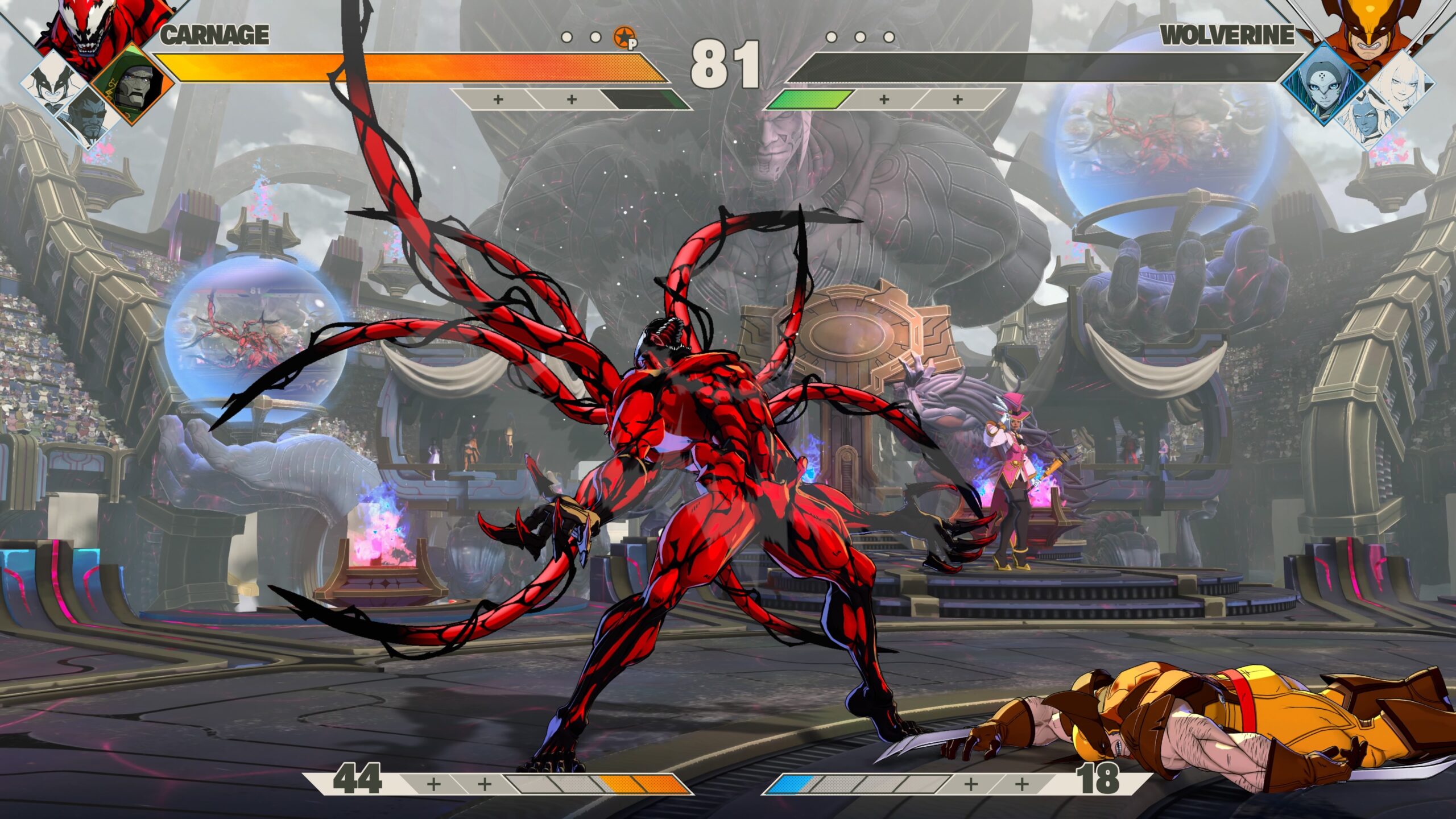
Marvel Tokon: Fighting Souls has other single player modes, with those being:
Survival: Try to get as many knockouts as you can while using the same vitality (health) meter. My best was eight.
Arcade: This isn’t your typical ladder mode. Instead, it’s presented like a set of different honeycombs with player chosen, branching, paths. The paths you choose will change who you’ll do battle with. This also adds replay value.
Arcadia Rumble: This mode turns player characters into chibis, and drops them into a themed arena with speed boosts, power-ups and platforming. The goal is to use basic punches (and the odd special attack) to knock out as many opponents as possible, with each one having two hearts. At the end of each round, the top two fight in the normal way.
As part of the secondary suite of single player modes, players are occasionally given the option to select soul cards that provide buffs. For instance, it’s possible to choose a card that will aid your vitality, or one that will boost your defence. Thankfully, this isn’t part of the story chapters.
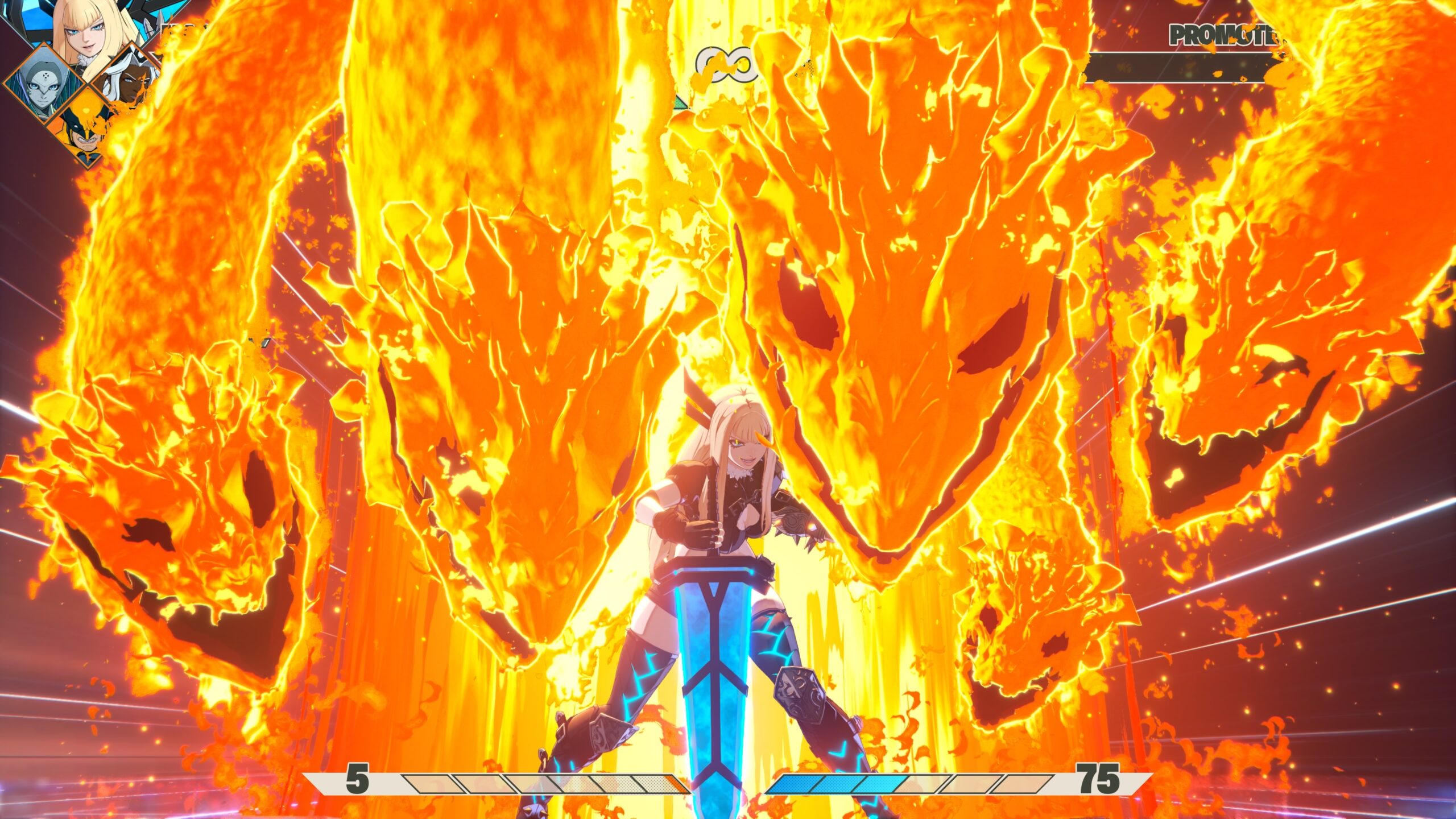
I honestly can’t see people putting much time into Arcadia Rumble, because it’s so basic, but at least it’s there. Then again, the impression that I get is that most people play fighting games for the online components and barely touch the single player. I guess I’m an outlier, because I’d rather play against the computer, as opposed to getting my ass handed to me repeatedly.
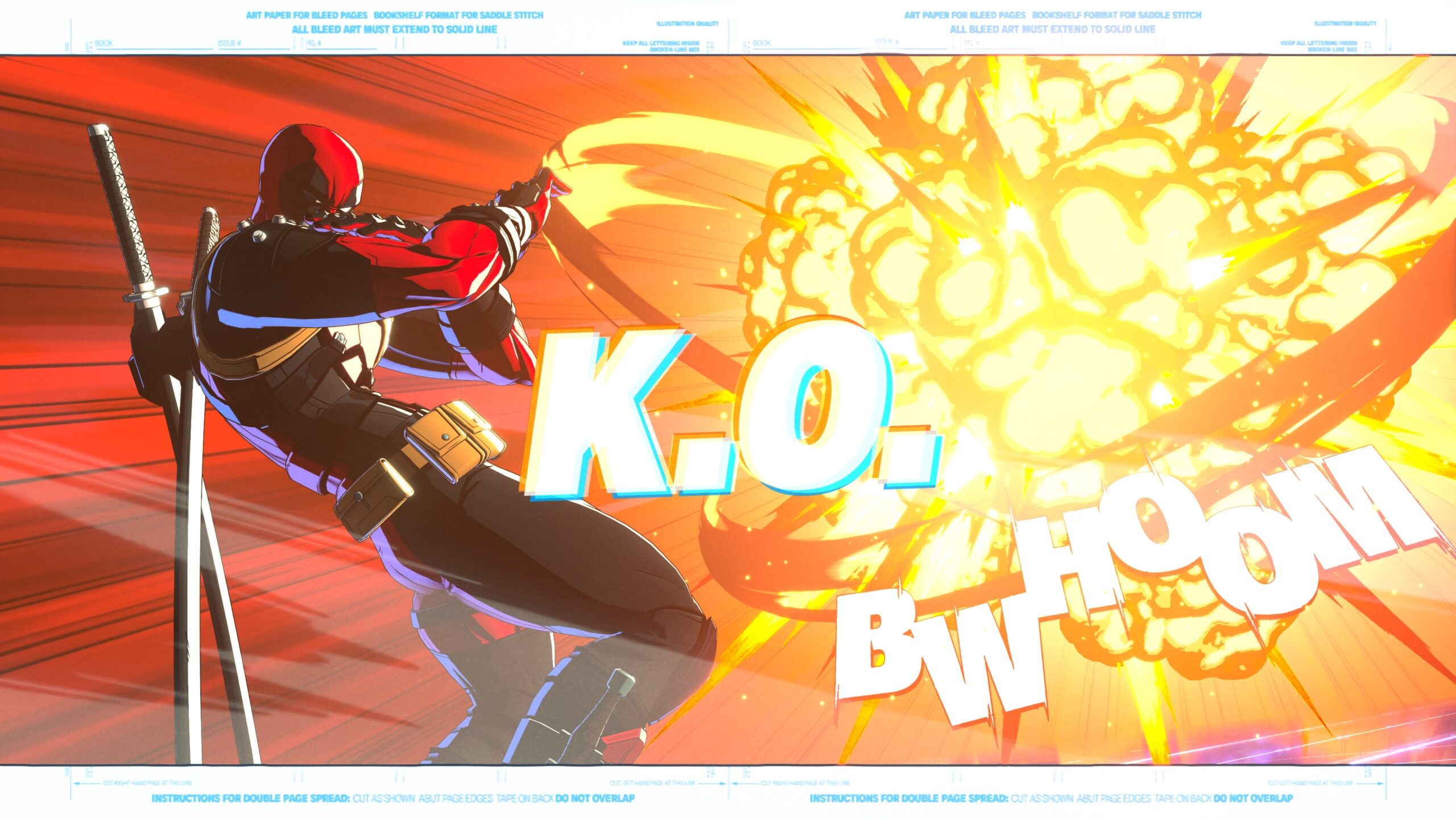
There is also a training mode, as well as Character Lessons which let you learn how to play each individual fighter. They all have their own playstyles, unique abilities, special attacks and animations. For instance, Deadpool has a special attack that pays homage to other games, and features different versions of himself.
As someone who isn’t a fighting game fanatic, I wish that the wording found in the move-set tutorials would have been clearer. It seems to differ based on the mode you’re in, too. Perhaps part of this is a localization issue, but certain things weren’t all that clear.
As mentioned above, Marvel Tokon: Fighting Souls isn’t like your typical fighting game. There’s the fact that you have teams, for one. Then, it differs from similar titles (like Marvel vs. Capcom) in that it has teams of four, and how all four characters share the same vitality meter. Yes, you read that right. As such, changing characters will not give players a reprieve and a second, third or fourth health bar.
Sharing a single health meter allows the fights in this game to be fast, and go quickly. Having this brevity forces players to think fast, and use their teams well. It’s possible to change characters by using button commands, but I found that this didn’t always work perfectly for me. Then, I noticed that it seemed like my other characters didn’t always unlock right away. At times, I only had one to switch to, and then the others would become available as the battle progressed. However, I still occasionally struggled with not getting the one I wanted, or the command not working perfectly. This is likely on me though.
As per usual, Marvel Tokon: Fighting Souls presents a complex fighting system that is thankfully accessible but tough to master. As such, it is good for both newcomers and veterans alike. It’s also good for people like me. On top of this, there are different difficulty modes.
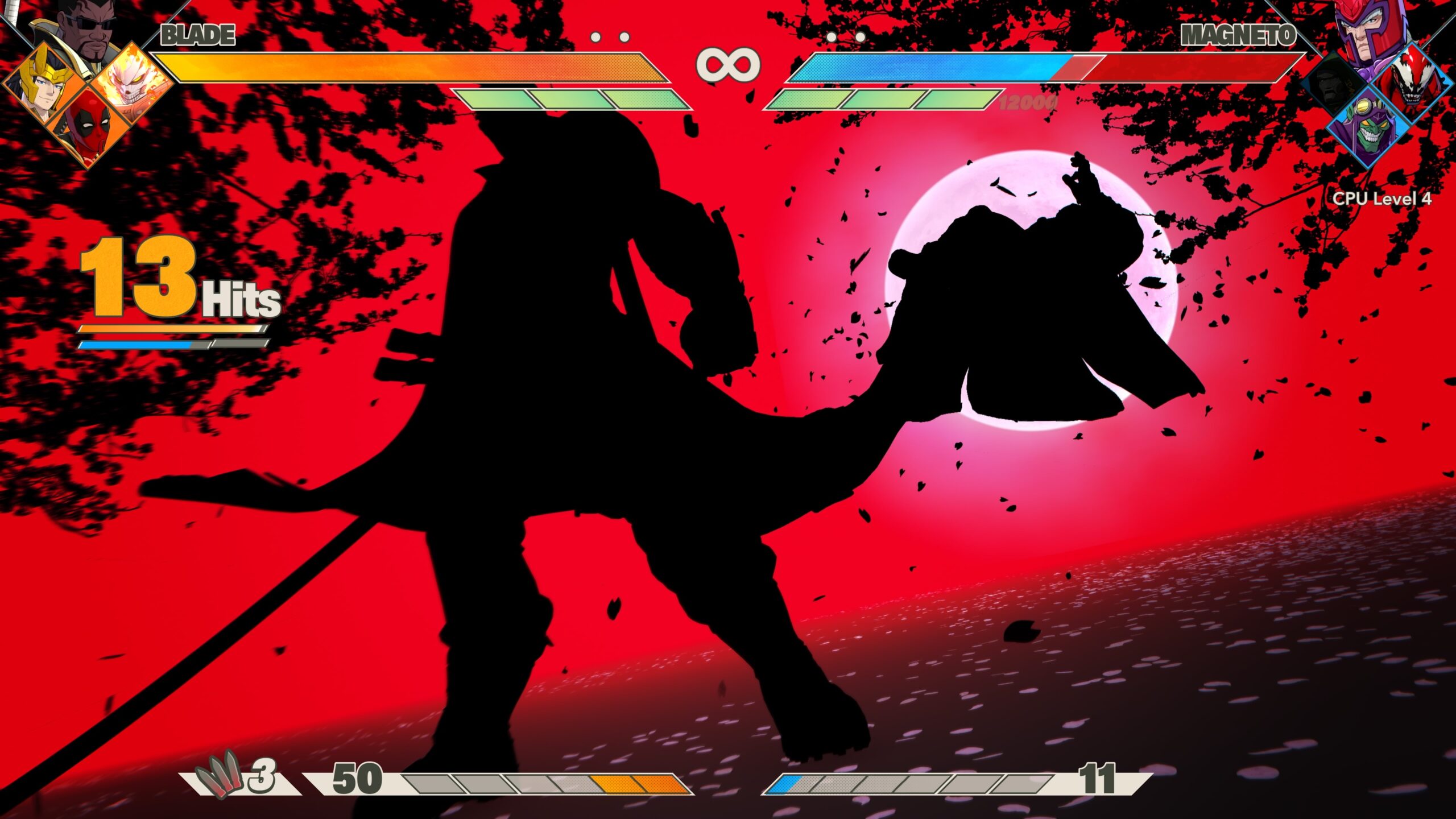
While I was originally worried about being able to complete the different story chapters, because there were no presented difficulty options (or any to be found in the mode’s settings menu), that fear was eventually allayed. Whenever I would lose (usually near the end of each one, when things got tougher, and again during the three stage boss battle), it would give me the option to lower the difficulty and restart. This was helpful and appreciated.
Now, it’s important to talk about the fighting system itself. I’ll do my best to explain it.
Obviously, the fighters all differ. There are some who are better for brute force, like Hulk. Then, there are others that are tougher to master, and play differently, like Loki’s ability to trick enemies, Storm’s use of the elements and Magik’s portals which she can move herself or her projectiles through. Wolverine is a brute who uses his rapid slashing claws, Spider-Man is fast and good at dodging while using his webs to move around, Iron Man can rely on his beams and Star-Lord is a tactical gunslinger. Some characters are better at range and using projectiles, while others are better at zoning or close-quarters combat. The goal is to find a team that works best for you. That’s why it’s nice that there are so many different options, including the boss character.
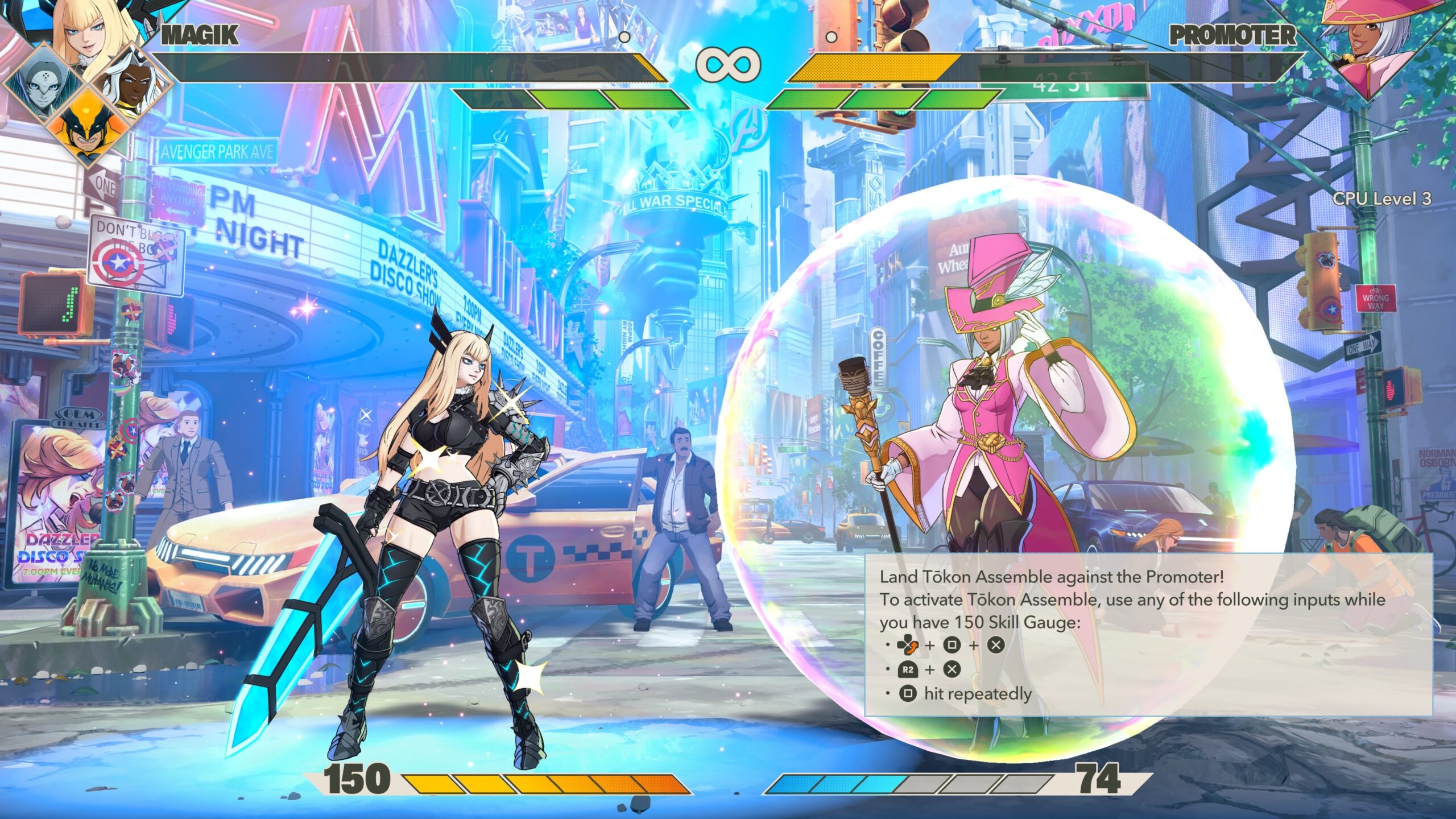
Different fighters have their own gimmicks too, like Ghost Rider’s vengeance gauge, which is presented as a speedometer and can dictate his damage output. There is also a meter at the bottom of the screen, which — when filled up to 150 — allows for a powerful special attack to be pulled off.
Being able to have teams of four allows one to call in different types of assists, along with team-up special moves. Certain things here seem to depend on the character, and their slot. Plus, if you find that your leader is easily countered by the other fighter, then it’s easy to change to someone else. You can even call a teammate in to assist, and then make the decision to switch to them afterwards, while they wait on screen with an L2 icon above them.
Of course, each fighter has the ability to do light attacks, heavier attacks, aerial ones and the like. They all also have their own specials and super moves, for lack of a better term. Plus, it’s possible to dash and block — something I need to learn to do more of. I tend to rely too much on uppercutting enemies into the air, then attacking them there. Sometimes, doing this and pressing the same attack button repeatedly will trigger a special attack. This doesn’t work well against those who are blocking.
The combat can be very fast and fluid, but there are also times where it feels a bit sluggish and doesn’t always work as intended. Surely, things will improve as the game gets older and receives more patches. It’s very good overall, though, and those (minor) issues don’t appear much, or affect things greatly.
Of course, the main draw here is online play. People are already very good at this game, and are sure to get better; especially those who are naturally good at fighting games and those who will play it regularly. I cannot compete with those people for numerous reasons, but I’ve tried. The single player stuff was more my speed.
Online play in Marvel Tokon: Fighting Souls means choosing ranked or casual play, the latter of which is required before you can play ranked. However, after waiting a little bit to find ‘someone’ in the middle of the night, I ended up doing more than one fight against someone, or a CPU fighter, that was far from casual.
The online suite features different regions and lobbies, rollback frames, and the ability to compete as chibi in the rumble scenario. There is also a mode where one can jump into the Arcadia map (with its themed regions and form(s) of travel), move around as a chibi, interact with others, spectate others’ fights and go to arcade machines to await a challenger for different variations of fighting. It’s also stated that the online mode records match footage, and allows players to save their replays locally.
Needless to say, there’s quite a bit of content and depth to Marvel Tokon: Fighting Souls. It’s an accessible, but deep, immersive and engaging fighting game, which offers a good amount of variety. This was my first time playing an Arc System Works (Guilty Gear, BlazBlue) game, but I liked it quite a lot.
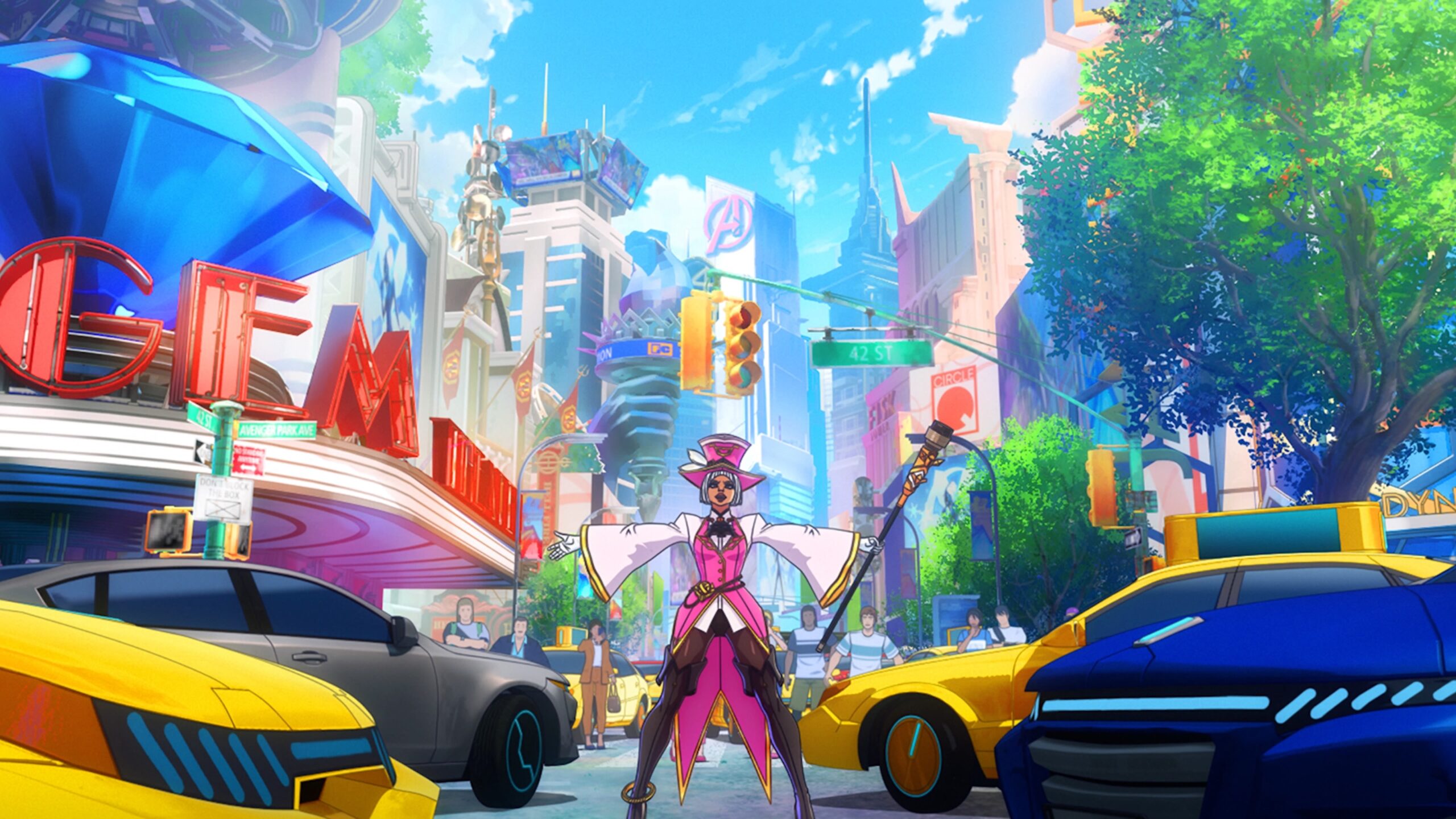
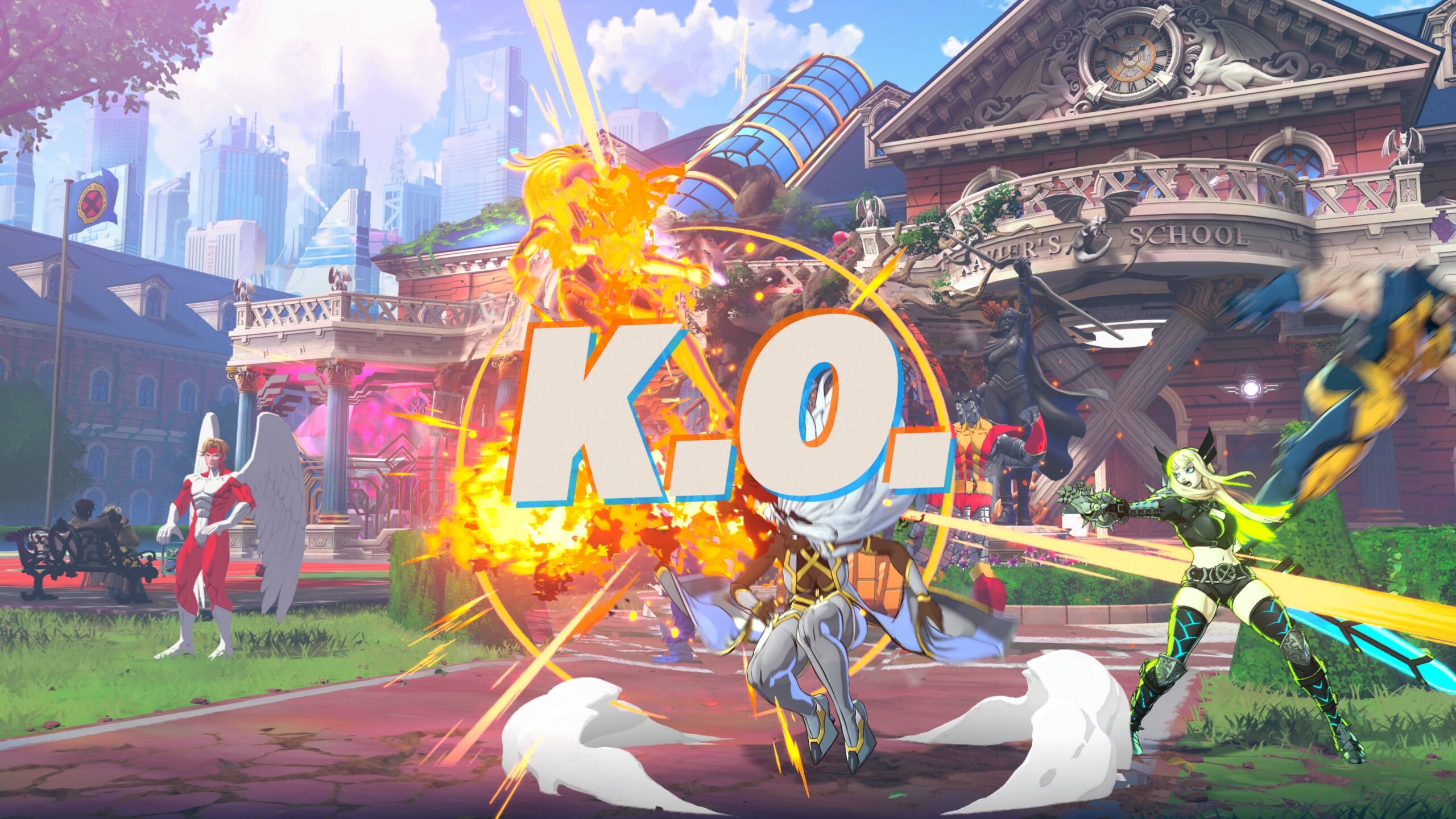
Upon starting this game, you’ll notice that it’s extremely colourful and incredibly beautiful. The art, environments, character models and animations are stunning, as are the stage transitions (when one character is sent flying to a different part of a map, like New York City). This is a very Japanese take on Marvel superheroes and supervillains, though, so expect it to be stylized and almost anime in some ways. I’m not a fan of anime, but I liked this.
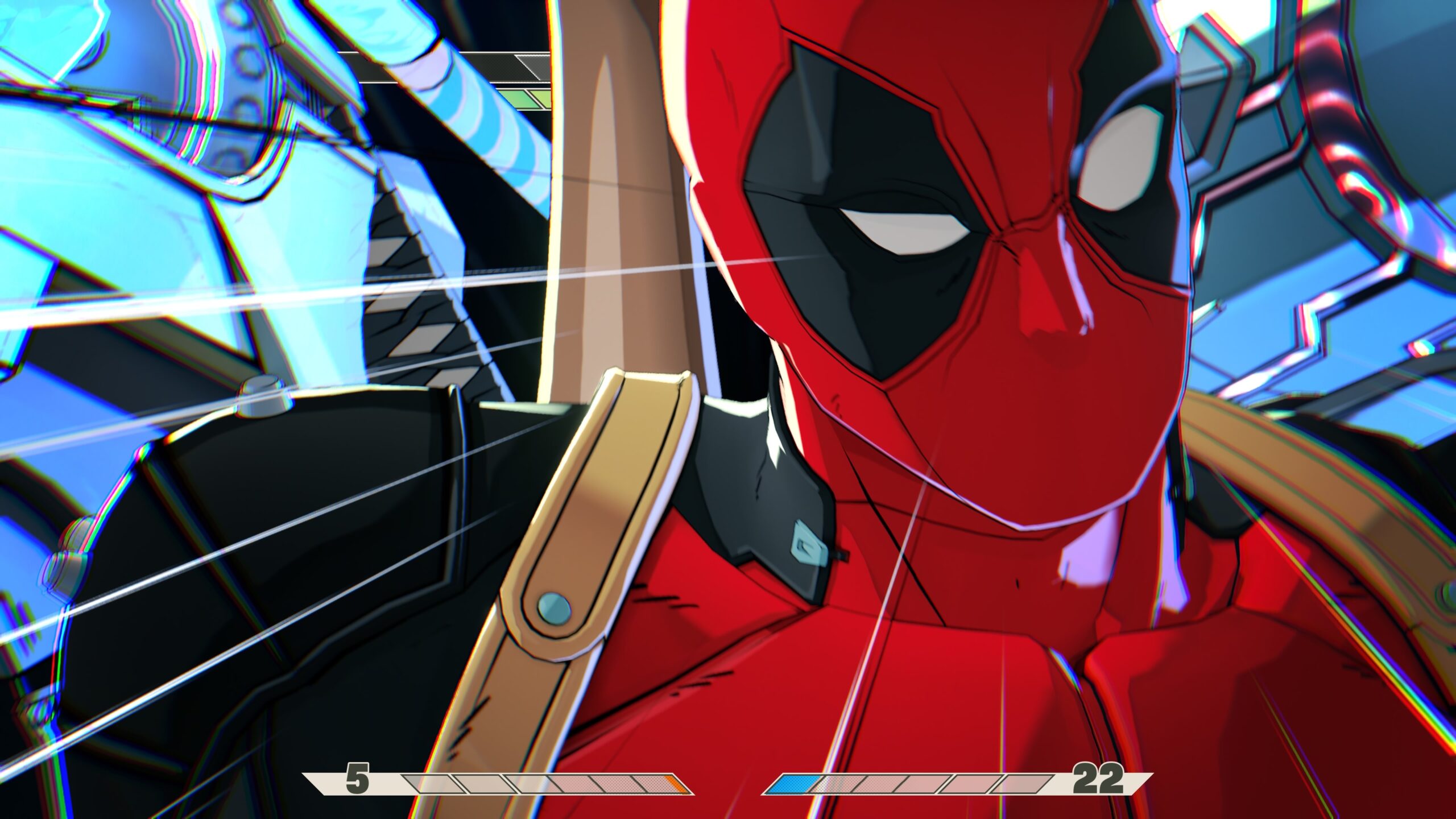
There are several different stages to be found within, and they are: New York City (day and night), Wakanda, Charles Xavier’s School campus, Asgard, Knowhere and the Savage Land. The latter comes with moving dinosaurs in the background, while others feature spectators, marquees, and Easter eggs. There’s lots of interesting animations going on in the backgrounds. On top of that, the fighter animations are very detailed, impressive and involved. A ton of effort was put into this game and it shows. It’s a treat for the eyes.
As mentioned much earlier in this surprisingly long review (sorry!), there’s full voice acting in the story chapters and cutscenes. It’s a mixed bag. Some characters sound ok, while others don’t sound very good, but it’s not a big deal given that this is a fighting game. I did not like the voice acting of Loki, or find the voice for human Robbie Reyes (Ghost Rider) to be very strong. The writing quality also varies, but it works. I found the X-Men chapter to have the best writing overall, and noted that each one was done by different writers and artists. None were familiar to me, though, as I haven’t read comics in a long time. I only like Marvel video games, as I’m beyond sick of the movies and TV shows.
There’s also a lot of music to be found within this game, as one would expect, including character themes. I found it to be good, and that certain songs stood out for good reason. There was even a metal styled song that played during the (final) boss battle, which I liked. Then again, I’m into metal. It was a nice surprise.
Going in, I wasn’t sure of what to think of Marvel Tokon: Fighting Souls, and wasn’t sure if I would be right to review it. After all, I’m not much of a fan of fighting games. However, I ended up really enjoying this one, and was impressed by it. It’s a very good game, which I’m hoping to play more of later today.
This review is based on the PlayStation 5 console exclusive, and was played on a PS5 Pro.